
Contents
Overview
Sudoku, also known as Number Place, has a fascinating history that spans centuries and continents. The concept of a number-placement puzzle originated in 19th century French newspapers, where similar puzzles were featured as a form of entertainment. However, the modern form of Sudoku as we know it today was first introduced in 1979 by Dell Magazines, and later popularized by the Japanese puzzle company Nikoli in 1986. Nikoli's founder, Maki Kaji, is often credited with coining the term 'Sudoku', which roughly translates to 'single number' in Japanese. The puzzle gained widespread popularity in the early 2000s, with the help of mathematicians like Martin Gardner and computer scientists like Donald Knuth, who wrote about Sudoku in their respective publications, including Scientific American and Byte magazine.
💡 How It Works
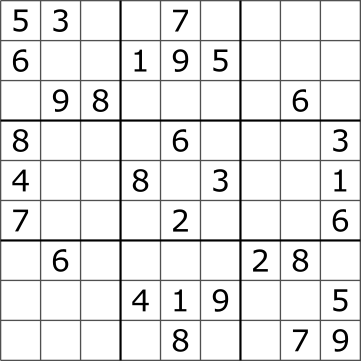
The objective of Sudoku is to fill a 9x9 grid with digits from 1 to 9, such that each row, column, and 3x3 subgrid contains each digit only once. The puzzle setter provides a partially completed grid, which, for a well-posed puzzle, has a unique solution. Solving Sudoku requires a combination of logical reasoning, pattern recognition, and trial-and-error, making it a challenging and engaging puzzle for people of all ages. Many experts, including Will Shortz, the puzzle editor for The New York Times, and Thomas Snyder, a world-renowned Sudoku champion, have developed various solving techniques and strategies to tackle Sudoku puzzles. These techniques often involve using algorithms and data structures, such as those developed by computer scientists like Google's Peter Norvig, to efficiently solve the puzzle.
🌎 Cultural Impact
Sudoku has had a significant impact on popular culture, with numerous variations and adaptations appearing in newspapers, magazines, and online platforms. The puzzle has been featured in various media outlets, including The Times, The Guardian, and USA Today, and has been the subject of several books, documentaries, and even a film. Sudoku has also inspired a community of enthusiasts, who share and solve puzzles online, and participate in competitions and events, such as the World Sudoku Championship, which is organized by the World Puzzle Federation. The puzzle has also been used in educational settings, as a tool for teaching logic, problem-solving, and critical thinking, with the help of educators like Dan Meyer and Jo Boaler, who have developed Sudoku-based curricula for schools.
🔮 Legacy & Future
As Sudoku continues to evolve and adapt to new technologies and platforms, its legacy and future remain bright. With the rise of mobile apps and online puzzle platforms, Sudoku has become more accessible than ever, with millions of people around the world solving puzzles every day. The puzzle has also inspired new variations and spin-offs, such as Sudoku X, Sudoku Jigsaw, and Sudoku Killer, which offer new challenges and twists on the classic game. As mathematicians and computer scientists continue to study and analyze Sudoku, new insights and discoveries are being made, shedding light on the puzzle's underlying structure and complexity, and inspiring new generations of puzzle enthusiasts, including those who participate in online forums like Reddit's r/Sudoku and Stack Overflow's Sudoku tag.
Key Facts
- Year
- 1979
- Origin
- Japan
- Category
- technology
- Type
- concept
Frequently Asked Questions
What is the objective of Sudoku?
The objective of Sudoku is to fill a 9x9 grid with digits from 1 to 9, such that each row, column, and 3x3 subgrid contains each digit only once.
Who popularized Sudoku?
Nikoli, a Japanese puzzle company, popularized Sudoku in 1986.
What is the history of Sudoku?
Sudoku has a rich history dating back to 19th century French newspapers, with the modern form being introduced in 1979 by Dell Magazines and popularized by Nikoli in 1986.
What are some variations of Sudoku?
Some variations of Sudoku include Sudoku X, Sudoku Jigsaw, and Sudoku Killer, which offer new challenges and twists on the classic game.
How has Sudoku impacted popular culture?
Sudoku has had a significant impact on popular culture, with numerous adaptations and appearances in media outlets, books, and documentaries, and has inspired a community of enthusiasts who share and solve puzzles online and participate in competitions and events.