
Contents
Overview
The concept of album-equivalent units (SEA) materialized in the mid-2010s as a direct consequence of the seismic shift in music consumption from physical media to digital downloads and, subsequently, streaming services. By the early 2000s, the music industry, once a titan of physical sales, faced an existential crisis. The advent of Napster and widespread digital piracy, followed by the legal but disruptive model of selling individual tracks on platforms like iTunes, decimated traditional album sales. Chart bodies and industry organizations, seeking to maintain the relevance of album rankings, began exploring ways to aggregate different forms of consumption into a single, comparable unit. This led to the formalization of SEA, with early iterations appearing on charts like Billboard's in 2014, initially as 'track equivalent albums' (TEA) and 'streaming equivalent albums' (SEA), eventually consolidating into the broader album-equivalent unit.
⚙️ How It Works
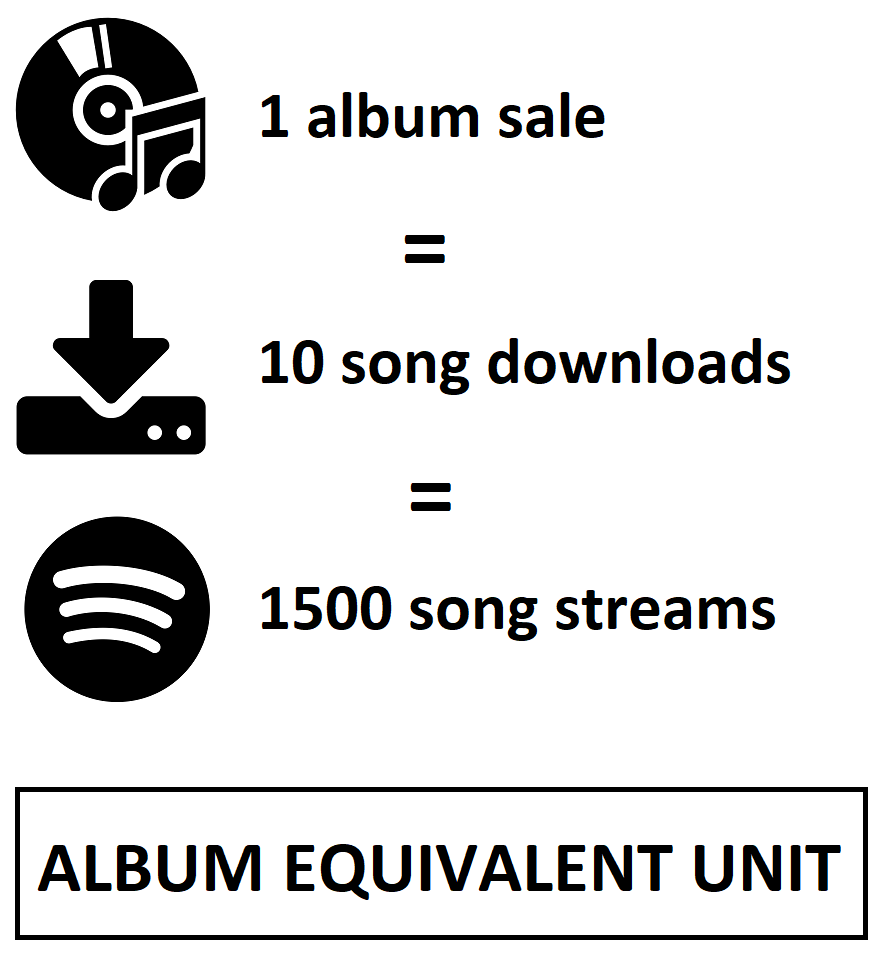
The mechanics of SEA involve a conversion formula that equates a certain number of streams or digital track downloads to one traditional album sale. While the exact ratios can vary slightly by chart provider and evolve over time, the general principle remains consistent. For instance, Billboard's methodology, a widely adopted standard, historically defined 1,500 premium streams (e.g., from a paid subscription service) or 10 individual track downloads as equivalent to one album sale. Lower-tier streams, such as those from ad-supported services, might be weighted differently. This conversion allows for a unified ranking system where an album's 'unit' sales can comprise a mix of physical purchases, digital album downloads, individual track downloads, and audio/video streams. The goal is to provide a more comprehensive picture of an album's overall popularity, reflecting how consumers engage with music across various platforms and formats in the digital ecosystem.
📊 Key Facts & Numbers
The impact of SEA on music consumption figures is staggering. Streaming has surpassed both physical sales and digital downloads to become the dominant format for music consumption in the United States. SEA metrics show albums achieving unit sales in the millions. The International Federation of the Phonographic Industry reported global recorded music revenues reached $26.2 billion in 2022, with streaming accounting for 67% of that total, underscoring the global scale of SEA's influence.
👥 Key People & Organizations
Several key figures and organizations have been instrumental in the development and implementation of SEA. Billboard magazine, through its chart division, has been a primary driver in establishing and refining SEA conversion formulas. The International Federation of the Phonographic Industry plays a crucial role in global reporting. Record labels like Universal Music Group, Sony Music Entertainment, and Warner Music Group have been pivotal in adapting to SEA. Early proponents of digital metrics, such as figures within Nielsen Music (now Luminate Data), provided the foundational data and analysis that informed SEA calculations.
🌍 Cultural Impact & Influence
SEA has fundamentally reshaped the music industry's landscape and cultural perception of album success. It transformed charts from a measure of pure sales into a more nuanced reflection of overall popularity and engagement, influencing how artists and labels approach album rollouts. For instance, Beyoncé's Lemonade (2016) famously debuted as an exclusive Tidal exclusive, a strategic move that generated immense buzz and ultimately contributed to its significant SEA upon wider release. This metric also impacts artist perception; an artist might have lower physical sales but achieve a higher chart position due to massive streaming numbers, altering public and industry perceptions of their success. The rise of SEA has also led to the proliferation of 'playlist culture,' where individual tracks gain traction through curated playlists on platforms like Spotify and Apple Music, directly boosting an album's SEA without necessarily driving full album purchases. This has, in turn, influenced songwriting and album sequencing, with artists potentially prioritizing 'streamable' tracks.
⚡ Current State & Latest Developments
The current state of SEA is one of continued dominance and ongoing refinement. Streaming remains the primary engine of music revenue, with SEA metrics forming the backbone of all major music charts globally. The industry is continuously evaluating and adjusting the conversion ratios for SEA to accurately reflect evolving consumption patterns and the value of different types of streams. For example, the debate around the weighting of audio versus video streams, and the impact of short-form video platforms like TikTok on music discovery and consumption, are active areas of discussion. The ongoing evolution of digital platforms and user behavior ensures that SEA will remain a dynamic and frequently re-evaluated metric.
🤔 Controversies & Debates
The introduction and widespread adoption of SEA have not been without controversy. A significant debate centers on whether SEA accurately reflects the artistic intent of an album as a cohesive body of work, or if it merely quantifies individual track popularity. Critics argue that the emphasis on streams can incentivize artists to create numerous short, 'hooky' tracks designed for playlist inclusion rather than a thoughtfully sequenced album experience. Another point of contention is the potential for manipulation, where bulk streams or artificial inflation could skew chart positions. Furthermore, the varying conversion rates across different platforms and chart providers can lead to inconsistencies in how success is measured. The debate also touches upon the perceived devaluation of music, with some arguing that the ease of access through streaming, even when converted to SEA, diminishes the perceived value of an album compared to a physical purchase.
🔮 Future Outlook & Predictions
Looking ahead, SEA is likely to remain the dominant metric for measuring album popularity, but its implementation will undoubtedly continue to evolve. As new technologies and platforms emerge, such as immersive audio experiences or further integration with social media, the definition and calculation of SEA will need to adapt. There's a growing discussion about how to better account for the value of full album listens versus single-track streams, potentially leading to more sophisticated weighting systems. Some futurists predict a move towards more holistic 'engagement metrics' that capture not just streams and downloads, but also social media interaction, conce
Key Facts
- Category
- culture
- Type
- topic