
Contents
Overview
Stereochemistry is the branch of chemistry dedicated to the three-dimensional spatial arrangement of atoms within molecules and how these arrangements dictate molecular properties and reactivity. It specifically examines stereoisomers – molecules with identical chemical formulas and connectivity but different spatial orientations. This subdiscipline is crucial because even minor differences in 3D structure can lead to vastly different physical, chemical, and biological behaviors, a phenomenon with critical implications in fields like pharmaceuticals, biochemistry, and materials science. Understanding stereochemistry allows chemists to design molecules with specific functions, predict reaction outcomes, and explain complex biological processes. The field's foundational principles, such as chirality and the Cahn-Ingold–Prelog priority rules, provide the language and tools to describe and analyze these intricate molecular architectures.
🎵 Origins & History
Louis Pasteur meticulously separated these enantiomorphic (mirror-image) crystals, demonstrating that molecular asymmetry was the cause. This groundbreaking work laid the foundation for understanding chirality. The theory that carbon atoms in organic molecules could be tetrahedral, with substituents arranged in three dimensions, explained Pasteur's findings and provided a theoretical framework for molecular geometry.
⚙️ How It Works
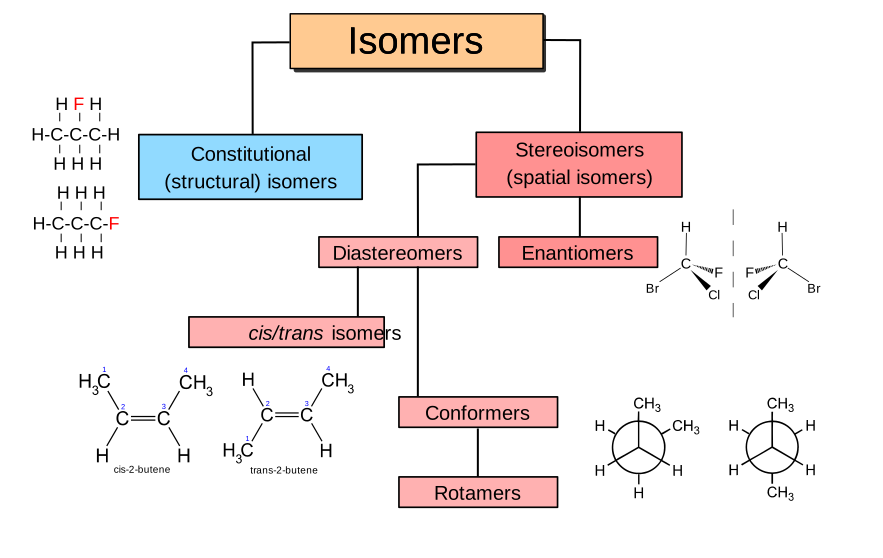
At its heart, stereochemistry deals with stereoisomers, which are compounds with the same molecular formula and connectivity but different spatial arrangements of atoms. The most fundamental concept is chirality, where a molecule is non-superimposable on its mirror image, much like a left hand is not superimposable on a right hand. These mirror-image pairs are called enantiomers. Molecules that are superimposable on their mirror images are called achiral. Other types of stereoisomers include diastereomers, which are stereoisomers that are not mirror images of each other, and meso compounds, which are achiral despite having chiral centers due to internal symmetry. The Cahn-Ingold–Prelog priority rules are a standardized system used to assign configurations (R or S) to chiral centers, providing a precise way to distinguish between enantiomers and diastereomers.
📊 Key Facts & Numbers
The drug thalidomide famously had one enantiomer that was a potent sedative but the other caused severe birth defects.
👥 Key People & Organizations
Key figures in stereochemistry include Louis Pasteur, whose work first demonstrated molecular asymmetry. Jacobus Henricus van 't Hoff and Joseph Achille Le Bel independently proposed the tetrahedral carbon atom, providing the theoretical basis for 3D molecular structures. Emil Fischer developed methods for synthesizing and determining the configurations of sugars, establishing the Fischer projection. Robert Burns Woodward was renowned for his total synthesis of complex natural products, often involving intricate stereochemical control. Organizations like the International Union of Pure and Applied Chemistry (IUPAC) establish nomenclature standards, while major pharmaceutical companies such as Pfizer, Merck, and Novartis invest heavily in stereoselective synthesis and analysis.
🌍 Cultural Impact & Influence
Stereochemistry's influence permeates numerous aspects of modern life and science. In medicine, the development of stereoselective drugs has revolutionized treatment for countless diseases, improving efficacy and reducing side effects. The field underpins our understanding of enzyme function, DNA replication, and protein folding in biochemistry. In materials science, controlling the stereochemistry of polymers can yield materials with vastly different properties, from flexible plastics to rigid fibers. Even in everyday items like fragrances, stereochemistry plays a role; for example, (R)-(-)-carvone smells like spearmint, while (S)-(+)-carvone smells like caraway. The ability to distinguish and synthesize specific stereoisomers has become a hallmark of advanced chemical synthesis and a critical factor in product development across industries.
⚡ Current State & Latest Developments
Current research in stereochemistry is pushing the boundaries of precision synthesis and analysis. Advances in asymmetric catalysis allow for the efficient and selective production of single enantiomers. Flow chemistry is increasingly being employed for stereoselective reactions, offering better control over reaction conditions and improved safety. Computational chemistry plays a vital role, with sophisticated modeling techniques predicting stereochemical outcomes and aiding in the design of new catalysts and molecules. Advanced NMR spectroscopy and chiral chromatography enable more accurate determination of enantiomeric purity and absolute configuration, even for complex molecules. The integration of artificial intelligence and machine learning is also accelerating the discovery of new stereoselective reactions and catalysts.
🤔 Controversies & Debates
One of the most enduring controversies in stereochemistry revolves around the concept of chirality itself and its potential origins in prebiotic Earth. While the vast majority of biological molecules are homochiral (composed of only one enantiomeric form), the origin of this homochirality remains a profound mystery. Theories range from spontaneous symmetry breaking to extraterrestrial seeding, but no definitive explanation has emerged. Another ongoing debate concerns the regulatory landscape for chiral drugs; while the U.S. Food and Drug Administration (FDA) and the European Medicines Agency (EMA) generally recommend single-enantiomer drugs when possible, the historical legacy of racemic mixtures (mixtures of equal parts enantiomers) and the cost of developing single enantiomers continue to fuel discussions about optimal regulatory approaches and economic feasibility.
🔮 Future Outlook & Predictions
The future of stereochemistry is inextricably linked to advancements in precision synthesis and our understanding of complex biological systems. We can anticipate the development of even more efficient and sustainable methods for producing enantiopure compounds, potentially utilizing biocatalysis and engineered enzymes to an even greater extent. The design of novel chiral materials with tailored electronic, optical, or mechanical properties for applications in quantum computing, advanced sensors, and targeted drug delivery is a promising frontier. Furthermore, as our ability to map and manipulate biological pathways at the molecular level grows, stereochemistry will be central to developing personalized medicines and understanding the intricate stereochemical dance of life. The ongoing quest to unravel the origin of homochirality in biology will likely continue to inspire fundamental research.
💡 Practical Applications
Stereochemistry has a vast array of practical applications. In the pharmaceutical industry, it's essential for developing drugs with improved safety and efficacy, such as atorvastatin (Lipitor) and sertraline (Zoloft), which are sold as single enantiomers. It's critical in the synthesis of agrochemica
Key Facts
- Category
- science
- Type
- topic