
Contents
- 🎵 Origins & History
- ⚙️ How It Works
- 📊 Key Facts & Numbers
- 👥 Key People & Organizations
- 🌍 Cultural Impact & Influence
- ⚡ Current State & Latest Developments
- 🤔 Controversies & Debates
- 🔮 Future Outlook & Predictions
- 💡 Practical Applications
- 📚 Related Topics & Deeper Reading
- Frequently Asked Questions
- References
- Related Topics
Overview
The genesis of Porter's Five Forces can be traced back to the late 1970s, a period when strategic thinking was evolving beyond simple SWOT analyses. Michael E. Porter, then a young professor at Harvard Business School, sought a more structured and empirically grounded method for understanding why some industries were consistently more profitable than others. His seminal work, "How Competitive Forces Shape Strategy," published in the Harvard Business Review in March 1979, introduced the framework. Porter drew heavily on the principles of industrial organization economics, particularly the work of Edward Mason and Joe Bain on market structure and monopoly power. The model was further elaborated in Porter's 1980 book, "Competitive Strategy: Techniques for Analyzing Industries and Competitors," solidifying its place as a critical tool for business strategists.
⚙️ How It Works
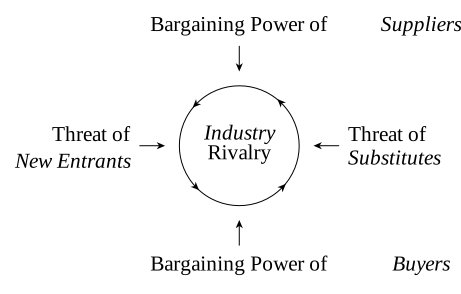
The framework operates by examining five distinct competitive forces that collectively shape an industry's structure and profit potential. First, the threat of new entrants assesses how easy or difficult it is for new companies to enter the market, considering factors like capital requirements and brand loyalty. Second, bargaining power of buyers evaluates how much leverage customers have to drive down prices, influenced by their concentration and the availability of alternatives. Third, bargaining power of suppliers scrutinizes the ability of input providers to raise costs, dependent on their own concentration and the uniqueness of their offerings. Fourth, the threat of substitute products or services considers the likelihood that customers will switch to alternatives outside the industry that fulfill the same basic need. Finally, rivalry among existing competitors analyzes the intensity of competition among current players, driven by factors like the number of competitors, industry growth rate, and product differentiation. A high intensity in any of these forces generally signals lower industry profitability.
📊 Key Facts & Numbers
The framework is applied across industries globally, with studies indicating its widespread adoption. For instance, a 2002 analysis by Monitor Company found that over 60% of Fortune 500 companies had used Porter's Five Forces in their strategic planning. In the airline industry, for example, the intense rivalry and high threat of substitutes often lead to profit margins below 5%, whereas the pharmaceutical industry, with high barriers to entry and strong brand loyalty, typically exhibits profit margins exceeding 15%. The global market for business consulting services, where this framework is a staple, was valued at over $250 billion in 2023. Research by Clayton M. Christensen and others has highlighted that industries with low scores across multiple forces, such as the software industry, tend to offer higher long-term profit potential.
👥 Key People & Organizations
The architect of this influential model is Michael E. Porter, a distinguished professor at Harvard Business School and a leading authority on competitive strategy. His work has profoundly shaped business education and practice. Key organizations that have championed and disseminated the framework include Harvard Business School itself, through its curriculum and publications like the Harvard Business Review, and numerous global management consulting firms such as McKinsey & Company, Boston Consulting Group (BCG), and Monitor Company. These firms frequently employ the Five Forces analysis in their client engagements, advising corporations on market entry, competitive positioning, and industry attractiveness assessments.
🌍 Cultural Impact & Influence
Porter's Five Forces has transcended academia to become a ubiquitous tool in the corporate world, influencing strategic decision-making across virtually every sector. Its clear, structured approach makes complex industry dynamics more digestible for executives and students alike. The framework has been instrumental in shaping the strategic discourse around market entry, competitive advantage, and industry profitability, appearing in countless business textbooks, case studies, and executive education programs worldwide. Its concepts are so ingrained that they are often discussed without explicit attribution to Porter, demonstrating their pervasive influence on how business strategy is conceived and taught. The model's enduring relevance is a testament to its ability to provide a consistent lens for analyzing competitive environments.
⚡ Current State & Latest Developments
As of 2024, Porter's Five Forces remains a standard in strategic analysis, though its application is increasingly nuanced. While still widely taught and utilized, contemporary discussions often integrate it with newer frameworks like Blue Ocean Strategy or disruptive innovation to capture dynamic market shifts. For instance, the rapid digital transformation across industries, exemplified by the rise of platform business models like Uber and Airbnb, presents new challenges and interpretations of these forces, particularly regarding barriers to entry and the nature of substitutes. The increasing pace of technological change, as seen with advancements in artificial intelligence and blockchain technology, necessitates continuous re-evaluation of how these forces manifest in evolving markets.
🤔 Controversies & Debates
Despite its widespread acceptance, Porter's Five Forces is not without its critics. A primary point of contention is its focus on industry structure rather than firm-specific resources and capabilities, a perspective championed by proponents of the Resource-Based View (RBV) of the firm, notably Jay Barney. Skeptics argue that the framework can be overly static, failing to adequately account for rapid technological change, dynamic capabilities, and the role of innovation in reshaping industries. Some critics, like Henry Mintzberg, have also questioned the prescriptive nature of the model, suggesting that strategy is often more emergent than planned. Furthermore, the framework's applicability to rapidly evolving digital industries, where network effects and data play a significant role, is a subject of ongoing debate.
🔮 Future Outlook & Predictions
The future outlook for Porter's Five Forces suggests continued relevance, albeit with evolving applications. As industries become more interconnected and dynamic, strategists will likely need to adapt the framework to incorporate factors like ecosystem dynamics, digital disruption, and the increasing importance of intangible assets. Future analyses may see a greater emphasis on the interplay between forces, rather than treating them as discrete elements. For example, the rise of gig economy platforms could simultaneously alter the threat of new entrants, buyer power, and supplier power in service industries. The challenge for strategists will be to integrate the Five Forces with emerging analytical tools to capture the complexity of 21st-century competition, potentially leading to a more fluid and interconnected model.
💡 Practical Applications
Porter's Five Forces analysis is a cornerstone of strategic planning and is applied across a vast array of business contexts. It is used by startups to assess market viability and identify competitive advantages before launch, helping founders like Elon Musk evaluate the potential of ventures like SpaceX or Tesla. Established corporations employ it for market entry decisions, competitive response planning, and identifying potential acquisition targets. For instance, a company considering entering the smartphone market would use the framework to evaluate barriers to entry (e.g., Apple's ecosystem, Samsung's manufacturing scale), the bargaining power of component suppliers (e.g., Qualcomm, Intel), and the intense rivalry with existing players like Google's Android ecosystem. It's also a vital tool in venture capital and private equity for evaluating investment opportunities.
Key Facts
- Year
- 1979
- Origin
- United States
- Category
- business
- Type
- model
Frequently Asked Questions
What are the five forces in Porter's analysis?
The five forces are: 1. Threat of new entrants, assessing how easily new competitors can enter an industry. 2. Bargaining power of buyers, evaluating customer influence on prices. 3. Bargaining power of suppliers, determining supplier influence on costs. 4. Threat of substitute products or services, considering alternatives that meet similar customer needs. 5. Rivalry among existing competitors, measuring the intensity of competition among current players. These forces collectively determine an industry's attractiveness and profit potential.
How does Porter's Five Forces help a business?
This analysis helps businesses understand the underlying drivers of competition and profitability within an industry. By identifying the strength of each force, a company can develop strategies to mitigate threats, exploit opportunities, and position itself for sustainable competitive advantage. For example, a firm might invest in building brand loyalty to reduce the threat of new entrants or seek exclusive supplier contracts to lessen supplier power.
Is Porter's Five Forces still relevant today?
Yes, Porter's Five Forces remains highly relevant as a foundational tool for strategic analysis in 2024. While the business environment has evolved with digital transformation and globalization, the core principles of competitive dynamics still hold. However, modern applications often integrate the framework with newer concepts like network effects, platform ecosystems, and disruptive innovation to provide a more comprehensive view of contemporary industries.
What is the difference between industry rivalry and threat of substitutes?
Industry rivalry refers to the competition among existing firms within the same industry, often characterized by price wars, advertising battles, and product innovation. The threat of substitutes, on the other hand, comes from products or services offered by companies in different industries that can fulfill the same customer need. For instance, within the airline industry, rivalry exists between Delta and United, while a substitute threat might come from high-speed rail or Zoom for business travel.
Can Porter's Five Forces be used for a startup?
Absolutely. Porter's Five Forces is invaluable for startups assessing market attractiveness and potential profitability. A startup founder can use the framework to understand barriers to entry they might face or overcome, gauge the power of potential customers and suppliers, identify substitute threats, and analyze the competitive intensity they will encounter. This analysis can inform crucial decisions about market selection, business model design, and resource allocation, helping to avoid industries with overwhelming competitive forces.
What are the limitations of Porter's Five Forces?
A significant limitation is its focus on industry structure, potentially overlooking firm-specific resources and capabilities that drive competitive advantage, as highlighted by the Resource-Based View (RBV). The model can also be perceived as static, struggling to fully account for rapid technological change, dynamic capabilities, and the emergent nature of strategy. Furthermore, its application to highly dynamic digital industries, where network effects and platform dynamics are paramount, is often debated.
How does this analysis predict industry profitability?
The analysis predicts profitability by assessing the collective strength of the five forces. Industries where the forces are weak (e.g., high barriers to entry, low buyer/supplier power, few substitutes, low rivalry) tend to be more attractive and offer higher profit potential. Conversely, industries where the forces are strong (e.g., low barriers to entry, high buyer/supplier power, many substitutes, intense rivalry) are less attractive and typically yield lower profits, often approaching normal profit levels as seen in highly competitive commodity markets.