
Contents
- 🎵 Origins & History
- ⚙️ How It Works
- 📊 Key Facts & Numbers
- 👥 Key People & Organizations
- 🌍 Cultural Impact & Influence
- ⚡ Current State & Latest Developments
- 🤔 Controversies & Debates
- 🔮 Future Outlook & Predictions
- 💡 Practical Applications
- 📚 Related Topics & Deeper Reading
- Frequently Asked Questions
- References
- Related Topics
Overview
The scientific study of ocean-atmosphere interactions traces its roots back to early maritime observations and the burgeoning fields of meteorology and oceanography in the 19th century. Pioneers like Matthew Fontaine Maury meticulously charted ocean currents and winds, laying groundwork for understanding their interconnectedness. The formalization of concepts like the Walker circulation in the early 20th century by Gilbert Walker provided crucial frameworks for understanding tropical weather patterns driven by oceanic heat distribution. The mid-20th century saw the development of sophisticated climate models, spurred by advancements in computing power and a growing awareness of climate variability, particularly after major events like the 1950s El Niño. The establishment of international research programs like the World Climate Research Programme in 1980 further consolidated global efforts to unravel these complex exchanges.
⚙️ How It Works
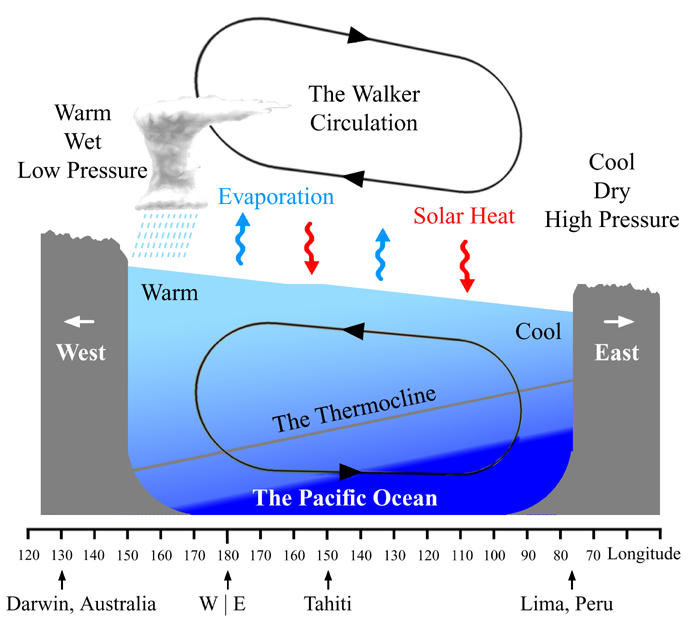
The core mechanism of ocean-atmosphere interaction involves the transfer of energy and mass across the air-sea interface. Solar radiation warms the ocean surface, leading to evaporation, which transfers heat and water vapor into the atmosphere. This atmospheric moisture can then condense, forming clouds and precipitation, releasing latent heat that fuels weather systems. Conversely, the atmosphere exerts stress on the ocean surface through winds, driving surface currents and mixing the upper ocean layers. Heat is also exchanged through conduction and radiation, with the ocean acting as a massive heat reservoir, moderating atmospheric temperatures. Changes in ocean temperature, such as during El Niño events, can alter atmospheric pressure gradients, leading to shifts in wind patterns and global weather anomalies, demonstrating a powerful feedback loop.
📊 Key Facts & Numbers
The ocean absorbs approximately 90% of the excess heat trapped by anthropogenic greenhouse gas emissions, a staggering figure that has led to a measurable increase in ocean heat content, with over 90% of this warming occurring in the upper 2000 meters. Since the pre-industrial era, the ocean has absorbed roughly 25-30% of anthropogenic carbon dioxide emissions, leading to a decrease in surface ocean pH by about 0.1 units, a process known as ocean acidification. Global sea levels have risen by approximately 20 cm since 1900, with thermal expansion of seawater and melting glaciers contributing significantly. The Gulf Stream alone transports about 1.5 petawatts of heat, equivalent to nearly 100 times the global electricity generation capacity. These interactions are not static; the rate of sea surface temperature increase has accelerated in recent decades, with the warmest years on record occurring post-2015.
👥 Key People & Organizations
Key figures in understanding ocean-atmosphere interactions include Syukuro Manabe, a pioneer in climate modeling who shared the 2021 Nobel Prize in Physics for his work on the physical modeling of Earth's climate. Klaus Hasselmann also shared this prize for his work on climate models and reliably quantifying variability. Organizations like the National Oceanic and Atmospheric Administration (NOAA) in the U.S. and the Met Office in the UK are at the forefront of research, operating vast observational networks and developing advanced climate models. The Intergovernmental Panel on Climate Change (IPCC) synthesizes global research, providing authoritative assessments of climate science, including the critical role of ocean-atmosphere exchanges. International collaborations through bodies like the Intergovernmental Oceanographic Commission (IOC) of UNESCO are vital for coordinating global research efforts.
🌍 Cultural Impact & Influence
The profound influence of ocean-atmosphere interactions permeates global culture and human activity. Maritime trade, fishing industries, and coastal communities have always been intrinsically linked to weather and ocean conditions. The dramatic impacts of phenomena like El Niño on global agriculture, fisheries, and disaster frequency have shaped economic and social histories worldwide. Artistic expressions, from maritime art to literature and film, often capture the awe and power of the ocean and its atmospheric connections. Public awareness of climate change, largely driven by observed changes in ocean temperatures and sea levels, has spurred environmental movements and policy debates, highlighting the deep societal relevance of these scientific processes.
⚡ Current State & Latest Developments
Current research is intensely focused on refining climate models to better capture the nuances of ocean-atmosphere coupling, particularly concerning extreme weather events and tipping points. Efforts are underway to expand and improve ocean observation systems, including autonomous floats like Argo floats and advanced satellite remote sensing, to provide higher-resolution data. Scientists are also investigating the role of ocean heat uptake in masking the full extent of atmospheric warming and the implications of this for future climate trajectories. The impact of melting Greenland and Antarctic ice sheets on ocean circulation and sea level rise remains a critical area of study, with ongoing research into potential feedback mechanisms. The development of early warning systems for climate-related disasters, heavily reliant on understanding these interactions, is also a major focus.
🤔 Controversies & Debates
A significant controversy revolves around the concept of a 'hiatus' or slowdown in the rate of global surface warming observed between roughly 1998 and 2012. Some argued this indicated a flaw in climate models, while others, including many oceanographers, pointed to increased ocean heat uptake as the primary reason for the apparent surface temperature plateau. The extent to which the ocean can continue to absorb excess heat and carbon dioxide without triggering more severe and rapid climate impacts is another point of intense scientific debate. Furthermore, the precise quantification of feedback loops, such as changes in cloud cover or ocean carbon uptake, remains a challenge, leading to a range of projections for future warming. The attribution of specific extreme weather events to anthropogenic climate change, driven by ocean-atmosphere interactions, is also a subject of ongoing scientific refinement and public discussion.
🔮 Future Outlook & Predictions
The future outlook for ocean-atmosphere interactions points towards continued warming and increased climate variability. Projections suggest that ocean heat content will continue to rise, driving further sea-level rise through thermal expansion and contributing to more intense heatwaves and storms. The rate of ocean acidification is expected to accelerate, posing significant threats to marine ecosystems, particularly coral reefs and shellfish. Scientists anticipate more frequent and severe El Niño and La Niña events, with cascading impacts on global weather patterns and resource availability. Research is also exploring potential 'tipping points' in the climate system, such as the potential collapse of major ocean currents like the Atlantic Meridional Overturning Circulation (AMOC), which could lead to abrupt and drastic regional climate shifts. The effectiveness of future mitigation strategies will heavily depend on accurately predicting and responding to these evolving interactions.
💡 Practical Applications
Understanding ocean-atmosphere interactions is crucial for a wide array of practical applications. Accurate weather forecasting, from daily forecasts to seasonal outlooks, relies heavily on models that incorporate these exchanges. Climate models, built upon this understanding, inform long-term planning for infrastructure development, agricultural practices, and water resource management. The fishing industry depends on predicting oceanographic conditions that influence fish populations, while coastal management strategies are designed to mitigate risks from sea-level rise and storm surges. Furthermore, the ocean's role as a carbon sink is central to global carbon cycle assessments and informs policies related to carbon capture and emissions reduction. Early warning systems for phenomena like hurricanes and typhoons save lives and reduce economic losses.
Key Facts
- Year
- Ongoing
- Origin
- Global
- Category
- science
- Type
- phenomenon
Frequently Asked Questions
What is the primary way oceans and the atmosphere interact?
The primary interactions involve the exchange of heat, moisture, and momentum. Solar radiation warms the ocean surface, leading to evaporation that transfers water vapor and latent heat into the atmosphere. Winds exert stress on the ocean, driving currents and mixing. The ocean also absorbs a significant portion of atmospheric carbon dioxide, influencing its chemistry. These exchanges are continuous and form the basis of global weather and climate systems, as detailed by researchers like Syukuro Manabe.
How do ocean-atmosphere interactions cause phenomena like El Niño?
During an El Niño event, weakened trade winds in the Pacific allow warm surface waters to shift eastward, leading to higher sea surface temperatures in the central and eastern Pacific. This altered ocean temperature gradient impacts atmospheric pressure, causing shifts in global wind patterns and precipitation. The Walker circulation is a key component that weakens or even reverses during El Niño, demonstrating a direct link between ocean conditions and atmospheric circulation, as first described by Gilbert Walker.
Why is the ocean's role in absorbing heat and CO2 so important?
The ocean acts as a massive thermal buffer, absorbing over 90% of the excess heat trapped by greenhouse gases. This significantly slows down the rate of atmospheric warming, but leads to increased ocean heat content and sea-level rise through thermal expansion. It also absorbs about 25-30% of anthropogenic carbon dioxide emissions, mitigating atmospheric CO2 levels but causing ocean acidification. This buffering capacity, while crucial, comes with profound consequences for marine life and global climate stability, a subject extensively studied by organizations like NOAA.
What are the biggest uncertainties in understanding ocean-atmosphere interactions?
Major uncertainties lie in precisely quantifying feedback loops, such as how changes in cloud cover or ocean carbon uptake will evolve with warming. The exact timing and impact of potential 'tipping points,' like the shutdown of the AMOC, remain subjects of intense research and debate. Furthermore, accurately predicting the frequency and intensity of extreme weather events driven by these interactions, and attributing them to specific causes, is an ongoing challenge for climate modelers like Klaus Hasselmann.
How do scientists measure these interactions?
Scientists employ a multi-pronged approach involving global networks of ocean buoys, Argo floats that measure temperature and salinity profiles, and satellite remote sensing for sea surface temperature, winds, and atmospheric moisture. Ships and research vessels collect in-situ data, and advanced climate models are used to simulate and predict future interactions. International collaborations, often coordinated by bodies like the IOC of UNESCO, are vital for gathering comprehensive global data.
What are the practical implications of ocean-atmosphere interactions for coastal communities?
Coastal communities face direct impacts from sea-level rise, driven by thermal expansion of seawater and melting ice sheets due to ocean warming. Increased intensity of tropical cyclones and storm surges, fueled by warmer ocean waters, poses significant risks. Changes in ocean currents and temperatures can also affect local fisheries, impacting livelihoods and food security. Understanding these interactions is critical for developing effective coastal adaptation and disaster preparedness strategies, as highlighted by NOAA's coastal resilience programs.
Will the ocean continue to absorb heat and CO2 indefinitely?
While the ocean has a vast capacity for heat and carbon dioxide absorption, these processes are not indefinite and come with significant consequences. Continued absorption of heat leads to rising sea levels and ocean deoxygenation. The saturation of the ocean's capacity to absorb CO2 will accelerate ocean acidification, threatening marine ecosystems. Scientists are actively researching the limits of these buffering capacities and the potential for abrupt changes as these limits are approached, a critical concern for future climate projections by the IPCC.