
Contents
Overview
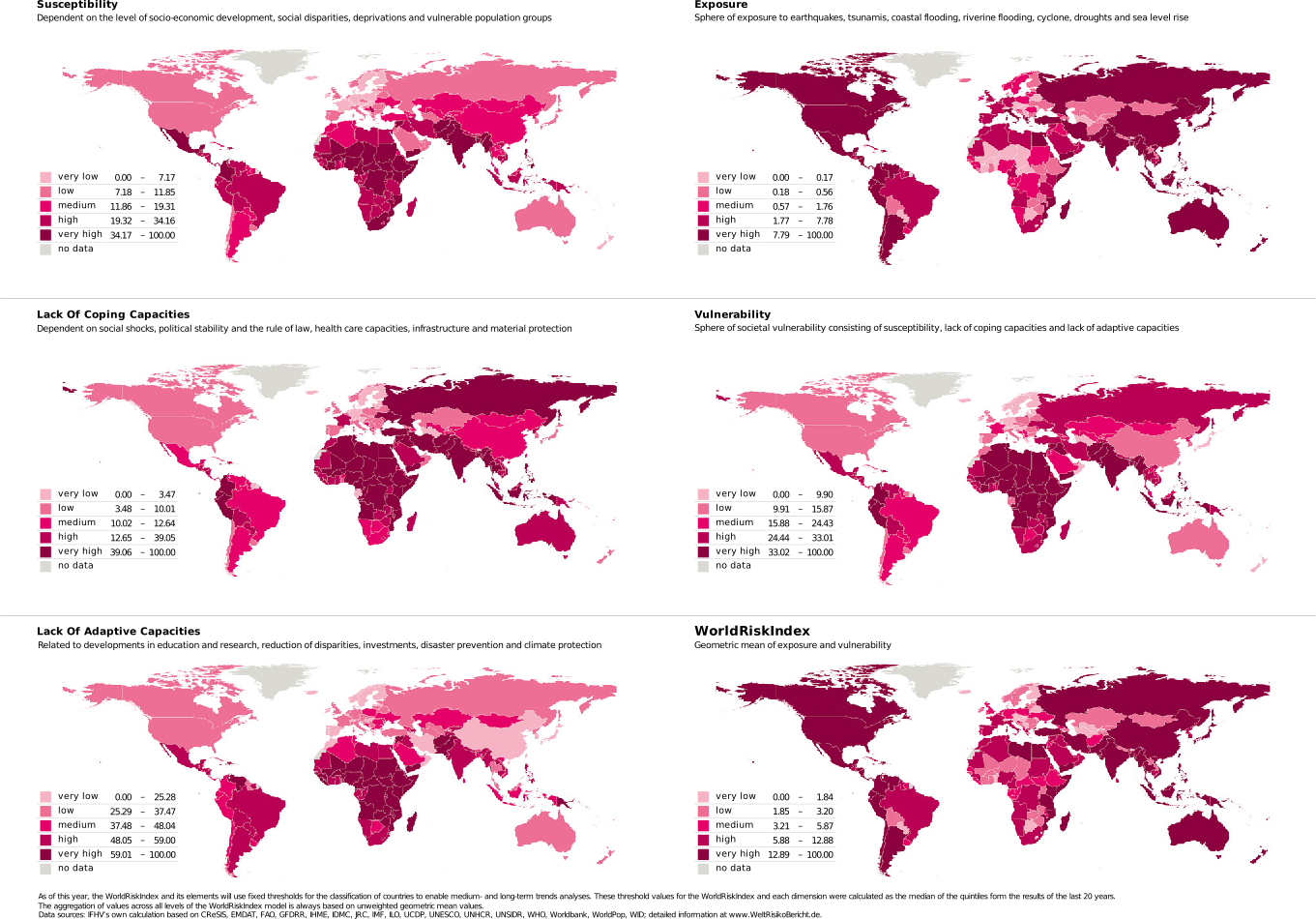
Natural disaster risk is a complex metric that quantifies the potential for harm and loss resulting from geophysical events such as earthquakes, volcanic eruptions, floods, droughts, and extreme weather. It's not merely about the hazard itself, but the intersection of that hazard with societal vulnerability and exposure. Globally, the economic toll is staggering. Understanding and mitigating this risk involves intricate modeling, robust infrastructure, and effective governance, particularly as climate change intensifies the frequency and severity of certain events. The World Risk Index attempts to synthesize these factors, ranking countries based on their exposure and susceptibility, highlighting that developing nations often bear a disproportionate burden despite contributing less to global climate drivers.
🎵 Origins & History
The formal study of natural disaster risk is a relatively recent discipline. Early efforts focused on understanding the physical hazard itself, drawing from seismology, meteorology, and hydrology. However, the paradigm shifted towards incorporating social and economic factors, recognizing that a hazard only becomes a disaster when it impacts vulnerable populations. Pioneers like Gilbert White began advocating for a more nuanced understanding of human interaction with natural hazards, challenging the deterministic view that floods were solely acts of nature to be endured. The establishment of organizations like the United Nations Office for Disaster Risk Reduction (UNDRR) marked a global commitment to systematizing risk assessment and reduction strategies.
⚙️ How It Works
Natural disaster risk is typically calculated as a function of hazard, exposure, and vulnerability. The 'hazard' component involves assessing the probability and intensity of a specific event, such as the likelihood of a magnitude 7.0 earthquake occurring in a region or the projected intensity of a Category 5 hurricane. 'Exposure' refers to the people, assets, and infrastructure located in harm's way – for instance, the number of homes and businesses situated within a coastal flood zone or near an active fault line. 'Vulnerability' encompasses the susceptibility of these exposed elements to damage, encompassing physical factors (e.g., building codes, infrastructure resilience), social factors (e.g., poverty, age demographics, access to information), economic factors (e.g., insurance coverage, economic diversification), and environmental factors (e.g., deforestation, degradation of natural buffers). Sophisticated models, often employing GIS technology and statistical analysis, integrate these three components to produce risk maps and indices, such as the World Risk Index.
📊 Key Facts & Numbers
The global economic impact of natural disasters is immense. Developing countries are disproportionately affected. Globally, floods and storms impacted the largest numbers of people. The IPCC projects that climate change will exacerbate these risks, increasing coastal flood exposure for hundreds of millions of people. According to the UNDRR, Asia experienced the highest number of disaster events between 1998 and 2017.
👥 Key People & Organizations
Several key individuals and organizations have shaped the field of natural disaster risk. Roger Bilham, a seismologist, has been instrumental in developing seismic hazard assessments and understanding earthquake probabilities, particularly in regions like the Himalayas. Katharine Hayhoe, a climate scientist, is a leading voice in communicating the risks associated with climate change and its impact on extreme weather events. The UNDRR plays a crucial role in coordinating global efforts, setting frameworks like the Sendai Framework, and publishing vital reports. Academic institutions like the University of Colorado Boulder's Natural Hazards Center and the University College London's Institute for Risk and Disaster Reduction are hubs for research and education. Insurance giants like Munich Re and Swiss Re are major players in quantifying and underwriting disaster risk, their annual reports often setting benchmarks for industry understanding.
🌍 Cultural Impact & Influence
Natural disaster risk assessment has profoundly influenced urban planning, architectural design, and public policy worldwide. The widespread adoption of building codes, such as the International Building Code (IBC), is a direct response to understanding seismic and wind risks. Insurance markets have evolved dramatically, with the development of catastrophe bonds and sophisticated risk modeling to price and transfer disaster-related financial liabilities. Public awareness campaigns have increased demand for preparedness measures and government investment in mitigation. The concept of 'resilience' has become a central theme, moving beyond mere response and recovery to emphasize the capacity of communities and systems to withstand and adapt to shocks, influencing everything from infrastructure development to social service provision. FEMA uses hazard maps for floodplains in land-use planning.
⚡ Current State & Latest Developments
The current state of natural disaster risk assessment is increasingly focused on the compounding effects of climate change and the interconnectedness of global systems. Advanced modeling techniques, incorporating machine learning and artificial intelligence, are being developed to predict event trajectories and impacts with greater precision. There's a growing emphasis on understanding cascading risks, where one disaster can trigger others – for example, an earthquake leading to a tsunami and subsequent nuclear meltdowns, as seen at Fukushima. The Global Assessment Report on Disaster Risk Reduction (GAR), published by the UNDRR, provides biennial updates on global disaster trends and risk profiles. In 2024, attention is particularly focused on the increasing frequency of extreme heat events, wildfires, and intense rainfall, alongside ongoing concerns about seismic activity in densely populated regions like the Pacific Ring of Fire. The development of early warning systems, such as those for tsunamis and severe weather, continues to be a critical area of investment and innovation.
🤔 Controversies & Debates
Significant controversies surround the quantification and communication of natural disaster risk. One major debate centers on the inherent uncertainty in predictive models, particularly for low-probability, high-impact events. Critics argue that over-reliance on complex models can lead to a false sense of security or, conversely, undue alarmism. Another point of contention is the equitable distribution of risk and the disproportionate burden faced by vulnerable populations, often in developing nations, who have fewer resources for mitigation and recovery. This raises ethical questions about global responsibility and climate justice. Furthermore, the role of insurance in disaster management is debated: while it can provide financial relief, it can also create moral hazard or lead to market withdrawal from high-risk areas, potentially exacerbating inequality. The framing of risk itself – whether as a purely scientific calculation or a socio-political construct – remains a subject of academic and policy discussion.
🔮 Future Outlook & Predictions
The future of natural disaster risk assessment will likely be shaped by continued advancements in data science, climate modeling, and a deeper integration of social science perspectives. We can exp
Key Facts
- Category
- science
- Type
- topic