
Overview
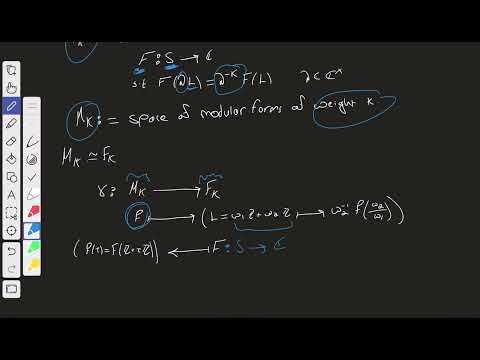
Modular forms are complex analytic functions with exquisite symmetry properties, deeply intertwined with number theory, algebraic geometry, and even physics. Their definition hinges on invariance under specific transformations of the complex upper half-plane, a concept that unlocks profound connections. Historically, they emerged from studying elliptic functions and quadratic forms, but their reach now extends to proving Fermat's Last Theorem and formulating string theory. Understanding modular forms requires grappling with concepts like lattices, modular groups, and L-functions, revealing a hidden order within seemingly chaotic mathematical structures. Their elegance and power continue to drive research across multiple disciplines.
Key Facts
- Year
- Late 19th Century (formalization)
- Origin
- Germany
- Category
- Mathematics
- Type
- Concept