
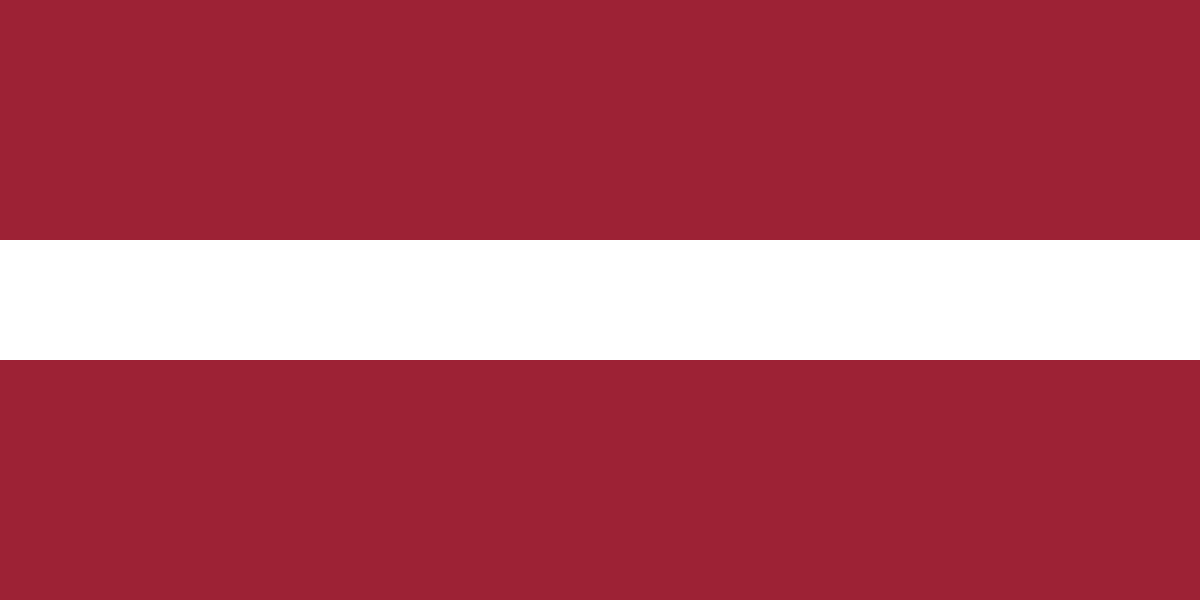
Contents
Overview
Latvia's story is one of resilience, marked by a long struggle for self-determination against powerful neighbors. The region was inhabited by ancient Baltic tribes for millennia before the arrival of German crusaders in the 13th century, who established the Livonian Confederation. This period saw the rise of influential cities like Riga, which became a major Hanseatic League trading post. Over subsequent centuries, Latvia fell under the dominion of the Polish-Lithuanian Commonwealth, then the Swedish Empire, and finally the Russian Empire in the early 18th century. The 19th century witnessed a burgeoning national consciousness, fueled by the collection of folklore and the promotion of the Latvian language, spearheaded by intellectuals like Krišjānis Barons. This culminated in the declaration of independence on November 18, 1918, following the collapse of the Russian Empire during World War I. The interwar period saw Latvia develop as a democratic republic, though it was occupied by the Soviet Union in 1940 and later by Nazi Germany during World War II, before being re-occupied by the Soviets until the restoration of independence in 1991.
⚙️ How It Works
As a modern nation-state, Latvia operates under a parliamentary democratic republic system. The Saeima, or Parliament, is the unicameral legislative body, responsible for passing laws and approving the government. The President, currently Edgars Rinkēvičs, serves as the head of state, with largely ceremonial duties, while the Prime Minister, currently Evika Siliņa, leads the executive branch and heads the cabinet. The judiciary is independent, with the Constitutional Court serving as the highest body for constitutional matters. Latvia's administrative divisions consist of 36 municipalities and 7 republican cities, with Riga serving as the central hub for governance and administration. The country's legal framework is largely harmonized with European Union directives, reflecting its integration into the bloc.
📊 Key Facts & Numbers
Latvia, with a land area of 64,573 square kilometers, is home to an estimated 1.83 million people as of recent data. The capital, Riga, boasts a population exceeding 600,000. The national currency transitioned from the Latvian Lats to the Euro on January 1, 2014. In 2023, Latvia's GDP was estimated to be around $43.7 billion USD, with a per capita GDP of approximately $23,800. The country's economy is diversified, with key sectors including services, manufacturing, and agriculture. Exports, particularly to EU member states, play a crucial role in its economic performance, accounting for over 70% of total trade. The unemployment rate has hovered around 7% in recent years.
👥 Key People & Organizations
Key figures in Latvia's modern history include Krišjānis Barons, often called the 'father of Latvian folklore' for his extensive collection of folk songs, and Rainis, a seminal poet and playwright whose works are foundational to Latvian literature. During the independence movement of the late 1980s, Māris Čaklais and Juris Rubenis were prominent voices. In politics, former Presidents like Vaira Vīķe-Freiberga and Valdis Zatlers have shaped the nation's trajectory. The Latvian Academy of Sciences and the University of Latvia are crucial institutions for research and education, fostering intellectual development. Organizations like the Latvian Institute work to promote the country's image internationally.
🌍 Cultural Impact & Influence
Latvia's cultural influence extends beyond its borders, particularly through its rich tradition of folk music and dance, often showcased during the Latvian Song and Dance Festival, a UNESCO Intangible Cultural Heritage event. The distinctive sound of the kokle, a traditional Latvian plucked string instrument, can be heard in contemporary folk and classical compositions. Latvian literature, notably the works of Andris Akmentiņš and Laima Muktupāvela, explores themes of national identity and historical memory. Riga's Art Nouveau architecture, a UNESCO World Heritage site, draws international attention and influences urban design aesthetics. The country's unique approach to environmentalism, particularly its extensive forest cover and commitment to sustainable practices, has also garnered global recognition.
⚡ Current State & Latest Developments
In the contemporary landscape, Latvia continues to solidify its position within the European Union and NATO, focusing on enhanced security cooperation and economic integration. The nation is actively investing in digital infrastructure and green technologies, aiming to become a leader in sustainable innovation. Recent developments include significant government initiatives to boost the defense sector in response to regional geopolitical shifts, alongside efforts to attract foreign investment in high-tech industries. The ongoing digital transformation is evident in the expansion of e-governance services and the promotion of remote work opportunities, particularly in cities like Riga and Liepāja. The country is also prioritizing energy independence through renewable sources, with a growing focus on wind and solar power generation.
🤔 Controversies & Debates
One of the most persistent debates surrounding Latvia concerns the integration of its substantial Russian-speaking minority. While the country has made strides in language policy and education, concerns about minority rights and political representation persist, often amplified by external geopolitical narratives. Another area of contention is the pace of economic development and the brain drain phenomenon, where skilled professionals seek opportunities abroad, impacting demographic trends and labor markets. Debates also arise regarding historical interpretations, particularly concerning the Soviet and Nazi occupations, and how these periods are memorialized and taught. Furthermore, the balance between preserving traditional Latvian culture and embracing globalized influences presents an ongoing cultural discussion.
🔮 Future Outlook & Predictions
The future outlook for Latvia appears to be one of continued strategic alignment with its Western allies, with an emphasis on bolstering national security and economic resilience. Projections suggest a sustained focus on developing a knowledge-based economy, leveraging digital advancements and green energy solutions. Increased investment in defense spending is anticipated, reflecting the evolving security environment in Eastern Europe. Latvia is also poised to play a more active role in regional cooperation, particularly within the Baltic states and Nordic countries frameworks, fostering closer ties in areas of trade, energy, and infrastructure. The nation's commitment to sustainability is expected to drive further innovation in renewable energy and circular economy models, potentially positioning it as a regional leader in green transition initiatives.
💡 Practical Applications
Latvia's practical applications are most evident in its contributions to international cybersecurity efforts, leveraging its expertise in digital governance and defense. The country serves as a hub for IT innovation, with numerous startups and established companies developing software solutions for global markets, particularly in areas like fintech and artificial intelligence. Its commitment to sustainable forestry management provides a model for other nations grappling with environmental conservation and resource utilization. Furthermore, Latvia's robust e-governance system, exemplified by the Latvian State Regional Development Agency's initiatives, offers practical blueprints for digital public services. The country's strategic location also makes it a key transit point for trade and logistics between Europe and Asia, facilitating international commerce.
Key Facts
- Category
- culture
- Type
- topic