
Contents
Overview
The intellectual roots of innovation diffusion stretch back further than Everett Rogers's 1962 magnum opus, Diffusion of Innovations. Early sociological studies by H. L. Mencken and Charles Cooley in the early 20th century touched upon the spread of ideas. However, Bryce Ryan and Neal Gross's 1943 study on the adoption of hybrid seed corn in Iowa provided empirical groundwork, identifying stages of adoption and influential communication channels. Rogers synthesized these and other findings, drawing from fields like sociology, anthropology, and communication studies, to formalize the theory. His work, first published in 1962 and revised multiple times until his death in 2004, became the definitive text, establishing the core principles that still guide our understanding of how innovations propagate through society, influencing everything from marketing strategies to public policy.
⚙️ How It Works
At its core, innovation diffusion operates through a predictable, albeit complex, process. An innovation, defined as an idea, practice, or object perceived as new by an individual or other unit of adoption, must first be communicated. Everett Rogers identified five key attributes of an innovation that influence its rate of adoption: relative advantage (is it better than what it replaces?), compatibility (does it fit existing values, experiences, and needs?), complexity (is it difficult to understand and use?), trialability (can it be experimented with on a limited basis?), and observability (are the results visible to others?). These attributes interact with the social system, influencing how quickly different groups of adopters, from innovators to laggards, embrace the new idea.
📊 Key Facts & Numbers
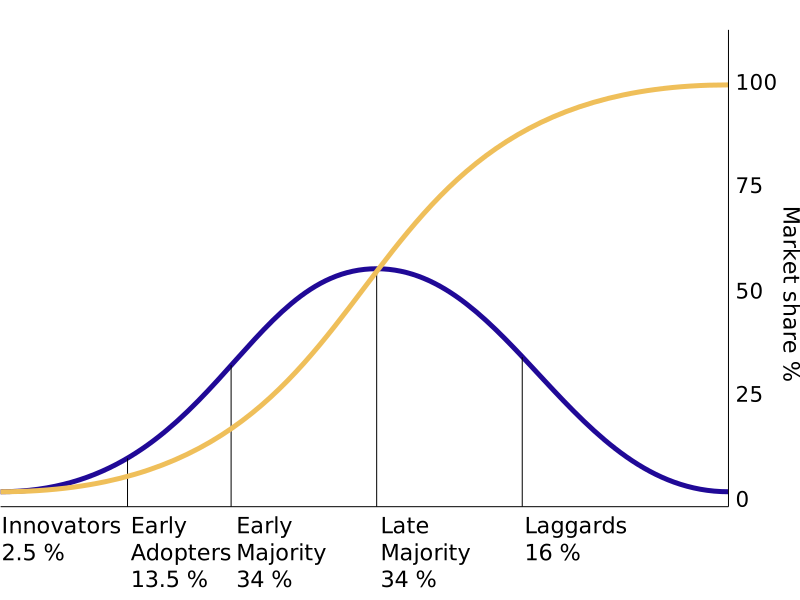
The adoption of innovations can be quantified and tracked with remarkable precision. Rogers's model suggests that approximately 2.5% of a population are innovators, followed by 13.5% early adopters, 34% in the early majority, another 34% in the late majority, and finally 16% as laggards. Reaching a 'critical mass' of adoption, often cited as around 15-20% of a social system, is a pivotal moment, after which adoption tends to accelerate rapidly. For instance, the adoption of smartphones in the United States, which began in earnest with the iPhone in 2007, surpassed 50% penetration by 2011, demonstrating a rapid diffusion curve driven by relative advantage and observability.
👥 Key People & Organizations
The architect of modern diffusion theory is undoubtedly Everett Rogers, whose 1962 book Diffusion of Innovations remains the foundational text. His work built upon earlier research by Bryce Ryan and Neal Gross, whose 1943 study on hybrid seed corn adoption provided crucial empirical data. Other key figures include Wilbur Schramm, a pioneer in communication studies, and Marshall McLuhan, whose ideas on media's role in societal change resonate with diffusion concepts. Organizations like the Rockefeller Foundation have also played a role by funding research and implementing programs that rely on diffusion principles, particularly in areas like global health and agriculture.
🌍 Cultural Impact & Influence
The impact of innovation diffusion theory on culture and practice is profound and pervasive. It has shaped how marketing professionals strategize product launches, how public health officials design campaigns for disease prevention, and how educators implement new teaching methodologies. The theory provides a lens through which to understand the spread of everything from social media trends on platforms like TikTok to the adoption of renewable energy technologies. Its framework helps explain why some innovations capture the public imagination and achieve rapid adoption, while others falter, offering actionable insights for accelerating positive change and understanding societal evolution.
⚡ Current State & Latest Developments
In the current landscape, innovation diffusion theory continues to be a vital analytical tool, particularly in the age of rapid technological advancement and global connectivity. The rise of digital platforms like Substack and Patreon exemplifies how new communication channels can dramatically alter diffusion rates. Researchers are actively exploring how network effects, influencer marketing, and algorithmic recommendations on platforms like X (formerly Twitter) and Instagram accelerate or disrupt traditional diffusion patterns. The ongoing development of artificial intelligence and its integration into everyday products presents a new frontier for studying diffusion, with debates arising about the speed and equity of AI adoption across different global demographics.
🤔 Controversies & Debates
Despite its widespread acceptance, innovation diffusion theory is not without its critics and controversies. A significant debate centers on the overemphasis on individual adopter categories, potentially overlooking systemic barriers and structural inequalities that hinder adoption for certain groups, particularly in developing nations or marginalized communities. Critics argue that the theory can sometimes be too teleological, implying an inevitable march towards progress that may not always be beneficial or equitable. Furthermore, the role of power dynamics and vested interests in shaping which innovations are promoted and adopted, often at the expense of more sustainable or socially beneficial alternatives, remains a contentious point, challenging the theory's seemingly neutral portrayal of the diffusion process.
🔮 Future Outlook & Predictions
Looking ahead, the future of innovation diffusion is likely to be shaped by increasingly interconnected global systems and the accelerating pace of technological change. We can anticipate further research into how virtual reality and augmented reality technologies will diffuse, potentially creating entirely new social systems and communication channels. The challenge of achieving equitable diffusion of critical innovations, such as climate change mitigation technologies and advanced medical treatments, will become paramount. Experts predict that understanding and manipulating diffusion dynamics will be key for policymakers and organizations aiming to address global challenges, with AI-driven predictive models potentially offering unprecedented insights into adoption trajectories.
💡 Practical Applications
The practical applications of innovation diffusion theory are vast and touch nearly every sector. In marketing, it informs strategies for product launches, guiding how to reach early adopters and leverage their influence to sway the early majority. In public health, it's used to design interventions for promoting healthy behaviors, such as smoking cessation programs or campaigns for safe sex practices. In education, it helps administrators and teachers understand how to introduce new pedagogical methods or technologies like interactive whiteboards. Even in agriculture, the theory guides the dissemination of improved crop varieties and farming techniques, as demonstrated by the initial studies on hybrid seed corn.
Key Facts
- Category
- theory
- Type
- topic