
Contents
Overview
The genesis of wavelength division multiplexing (WDM) can be traced back to the early days of fiber optics in the late 1960s and 1970s, with foundational work by pioneers like Charles K. Kao, who received the Nobel Prize in Physics in 2009 for his work on transmitting light in fibers for telecommunications. Early WDM systems were rudimentary, often using just two wavelengths to double capacity. The concept of dense WDM, however, emerged as researchers sought to push the limits of fiber capacity further. By the late 1980s and early 1990s, advancements in laser technology and optical filters made it feasible to pack wavelengths much closer together. Companies like Corning and Alcatel (now part of Nokia) were instrumental in developing the components and systems that defined early DWDM, paving the way for its commercial deployment in the late 1990s, particularly by telecommunications giants such as AT&T and Verizon.
⚙️ How It Works
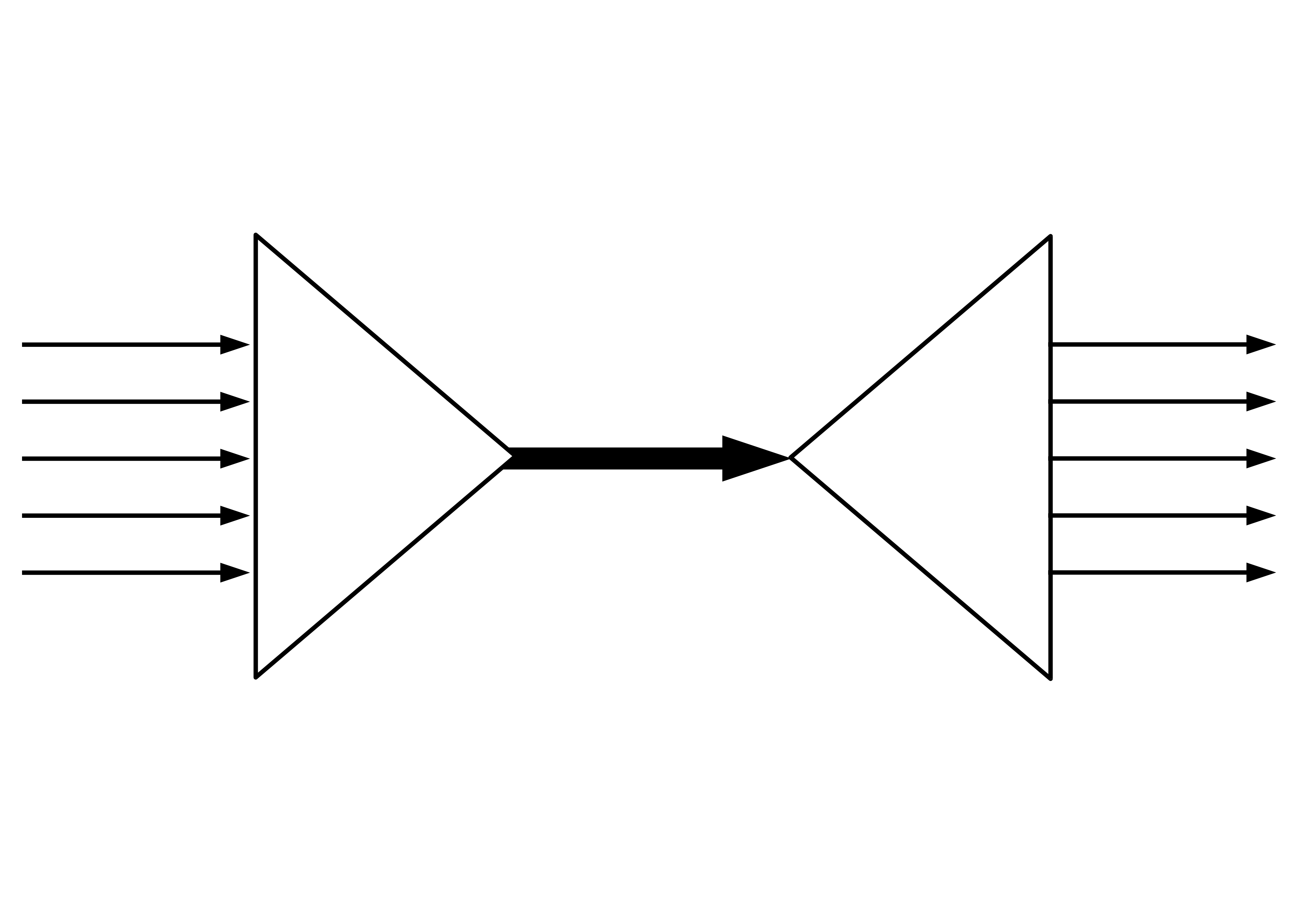
DWDM operates by leveraging the unique properties of light. At the transmission end, multiple lasers, each precisely tuned to a specific, narrow wavelength within the infrared spectrum (typically around 1550 nm), are used to modulate different data streams. These modulated light signals are then combined using a passive optical device called a multiplexer, which merges them onto a single strand of optical fiber without electrical conversion. As the combined light travels through the fiber, it experiences attenuation and dispersion, but advanced components like erbium-doped fiber amplifiers (EDFAs) are used to boost the signal strength at regular intervals. At the receiving end, a demultiplexer separates the combined light back into its individual wavelengths, with each wavelength being directed to a separate photodetector for demodulation back into its original data stream. The key differentiator for DWDM is the extremely close spacing of these wavelengths, often just 0.4 nm or 0.8 nm apart, enabling dozens to hundreds of channels on a single fiber.
📊 Key Facts & Numbers
A single strand of fiber optic cable employing DWDM can carry an astonishing amount of data. Modern DWDM systems can support anywhere from 40 to 160 channels, with some experimental systems pushing beyond 200 channels. Each channel can typically operate at speeds of 10 Gbps, 40 Gbps, 100 Gbps, or even 400 Gbps. This means a single fiber could potentially transmit over 16 terabits per second (Tbps) of data—that's 16,000,000,000,000 bits per second. The global optical networking market, heavily reliant on DWDM, was valued at approximately $17.5 billion in 2023 and is projected to grow significantly. The cost per bit transmitted has plummeted due to DWDM's efficiency, making high-speed internet and cloud services economically viable.
👥 Key People & Organizations
Key figures in the development and deployment of DWDM include Charles K. Kao, whose foundational work on fiber optics was essential. Early commercialization efforts were driven by engineers and product managers at companies like Corning, Ciena Corporation, Nokia Networks (formerly Alcatel-Lucent), and Huawei Technologies. David Lee, a key figure at Corning, was instrumental in developing low-loss optical fibers that made DWDM practical. Al Ghalimi is recognized for his contributions to DWDM system design and optimization at Ciena. The telecommunications carriers themselves, such as AT&T, Verizon, and Deutsche Telekom, were crucial early adopters and investors, driving demand and pushing for higher performance standards.
🌍 Cultural Impact & Influence
DWDM has fundamentally reshaped the telecommunications landscape, enabling the explosive growth of the internet and digital services. It's the invisible backbone that supports global data traffic, powering everything from Netflix streaming and Facebook feeds to cloud computing and international financial transactions. The ability to dramatically increase bandwidth without laying new fiber has saved telecommunication companies billions of dollars and reduced the environmental impact of network expansion. Its influence extends beyond core networks, finding applications in data centers for high-speed interconnections and even in scientific research for high-performance computing. The ubiquity of high-speed internet access worldwide is a direct consequence of DWDM's capacity-multiplying capabilities.
⚡ Current State & Latest Developments
The relentless demand for bandwidth continues to drive DWDM innovation. Current developments focus on increasing channel count and individual channel speeds, with 400 Gbps and 800 Gbps channels becoming more common, and research into 1.6 Tbps channels underway. Companies are also exploring more flexible DWDM architectures, such as software-defined networking (SDN)-controlled optical networks, allowing for dynamic allocation of wavelengths. The integration of photonic integrated circuits (PICs) is miniaturizing DWDM components, reducing power consumption and cost. Furthermore, advancements in coherent optics are enabling higher spectral efficiency and longer transmission distances, pushing the boundaries of what's possible on a single fiber.
🤔 Controversies & Debates
One persistent debate revolves around the cost-effectiveness and complexity of DWDM versus CWDM, especially for smaller networks or metro deployments. While DWDM offers superior capacity and spectral efficiency, its reliance on more precise and expensive lasers and filters can make it overkill for certain applications. Another point of contention is the energy consumption of DWDM systems, particularly the amplifiers and transponders, which can be significant. There's also ongoing discussion about the future role of DWDM as new transmission technologies, like free-space optical communication for satellite networks, gain traction, though DWDM is expected to remain dominant for terrestrial fiber for the foreseeable future.
🔮 Future Outlook & Predictions
The future of DWDM is intrinsically linked to the growth of data. As artificial intelligence, virtual reality, and the Internet of Things (IoT) continue to proliferate, the demand for bandwidth will only accelerate. We can expect to see continued increases in channel count and speed, potentially reaching 1 Tbps per channel and hundreds of channels per fiber within the next decade. The development of programmable optics and more intelligent network management systems will allow for greater flexibility and automation. Furthermore, DWDM is likely to be integrated more seamlessly with other networking technologies, creating a more unified and efficient global communication infrastructure. The ultimate limit will be dictated by the Shannon-Hartley theorem and the physical properties of light and fiber.
💡 Practical Applications
DWDM's primary application is in the core and metro networks of telecommunications service providers, enabling them to deliver high-speed internet, voice, and video services to a vast customer base. It's also critical for connecting major data centers, facilitating the massive data transfers required for cloud computing and content delivery networks. Financial institutions use DWDM for high-frequency trading and secure data transmission between trading hubs. Research institutions leverage it for high-performance computing clusters and distributed scientific experiments. Even enterprise networks are increasingly adopting DWDM for high-capacity inter-building or campus connectivity where traditional Ethernet limitations are reached.
Key Facts
- Category
- technology
- Type
- topic