
Contents
Overview
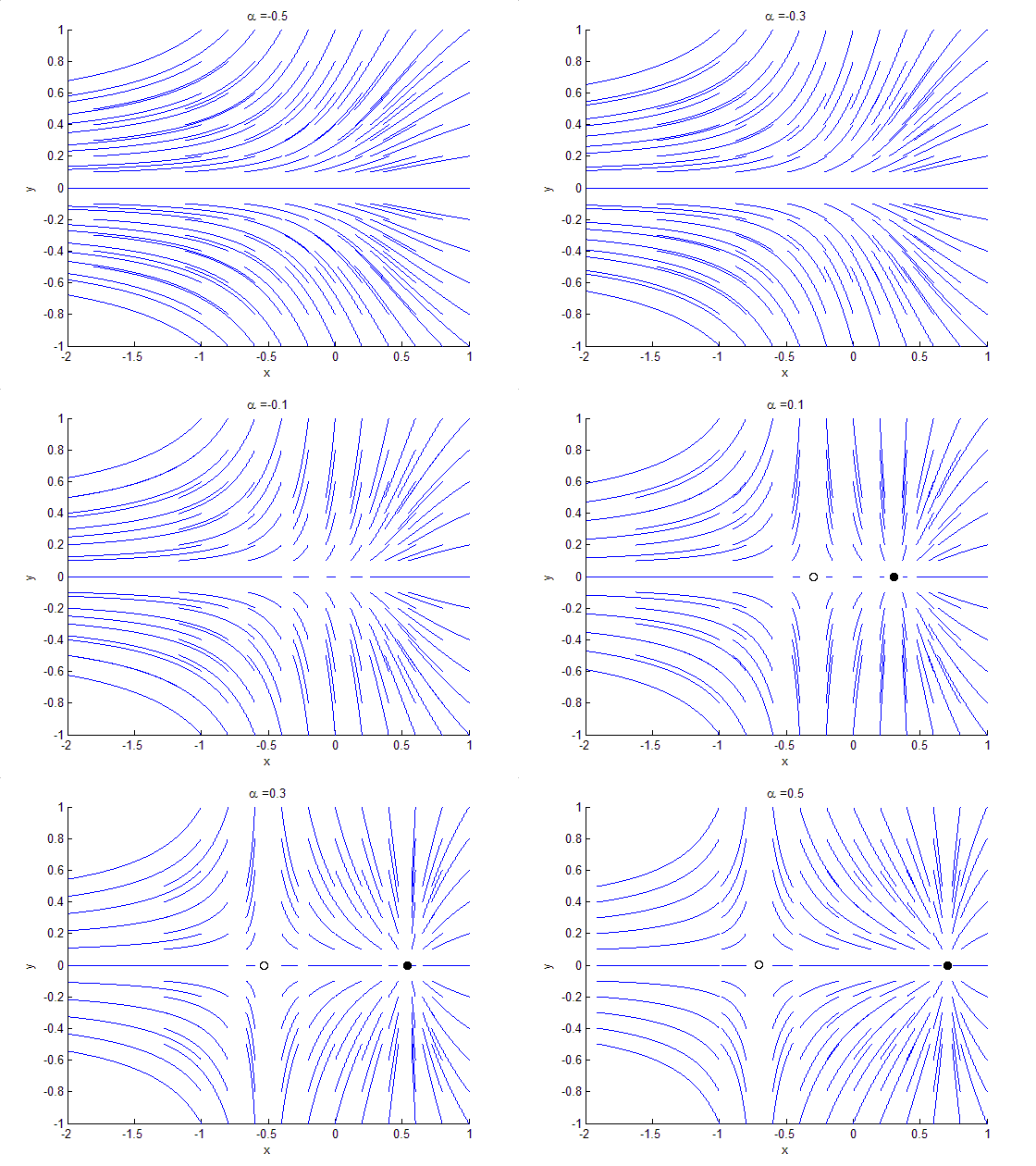
At its core, bifurcation theory examines how the solution set of a system changes qualitatively as a parameter is varied. Imagine a system described by a set of equations, and within those equations are parameters—variables that can be adjusted. When a parameter crosses a critical value, known as a bifurcation point, the system's behavior can fundamentally alter. For instance, a stable equilibrium point might split into two, or a stable limit cycle might emerge from a stable fixed point. These changes are topological; they represent a restructuring of the phase space. The theory classifies these changes into generic types, such as saddle-node, transcritical, pitchfork, and Hopf bifurcations, each characterized by specific algebraic and geometric properties. Understanding these generic types allows mathematicians and scientists to predict the qualitative behavior of complex systems without needing to solve them explicitly for every parameter value.
⚙️ How It Works
Bifurcation phenomena are ubiquitous, with countless examples documented across scientific disciplines. In physics, the onset of convection in a fluid layer heated from below, described by the Bénard convection problem, exhibits a pitchfork bifurcation at a critical Rayleigh number. The laser transition from spontaneous to stimulated emission is another classic example, involving a supercritical Hopf bifurcation. In biology, population dynamics can undergo bifurcations leading to extinction or stable coexistence, as seen in models like the logistic map which famously displays period-doubling bifurcations leading to chaos. The study of neural networks also reveals bifurcations in firing patterns and network states.
📊 Key Facts & Numbers
Bifurcation theory has profoundly influenced how we model and understand emergent phenomena across science and engineering. It provides a conceptual language for describing phase transitions, such as the change from water to ice, or the onset of magnetism. In biology, it helps explain pattern formation in morphogenesis and the sudden shifts in ecological systems. Its influence extends to the design of control systems and the understanding of critical phenomena in materials science.
👥 Key People & Organizations
Current research in bifurcation theory is pushing the boundaries of complexity and application. Advances in computational mathematics and algorithms, such as those developed by Leonid Kuznetsov, enable the analysis of higher-dimensional systems and more intricate bifurcation structures. There's a growing focus on understanding bifurcations in stochastic systems and networks, reflecting the inherent randomness and interconnectedness of real-world phenomena. Researchers are exploring novel bifurcation scenarios in areas like quantum mechanics, fluid dynamics, and computational biology. The development of machine learning techniques is also beginning to intersect with bifurcation analysis, offering new ways to detect and classify bifurcations in large datasets. The ongoing quest to understand the transition from order to chaos remains a central theme.
🌍 Cultural Impact & Influence
While bifurcation theory is a well-established mathematical framework, certain aspects remain subjects of debate and ongoing research. One area of contention is the precise definition and classification of 'generic' bifurcations, particularly in infinite-dimensional systems or when considering non-smooth perturbations. The practical application of bifurcation analysis to highly complex, real-world systems often faces challenges due to the difficulty in precisely identifying all relevant parameters and their ranges. Furthermore, the interpretation of bifurcations in fields like economics or social science can be controversial, as attributing sudden societal shifts solely to parameter variations can oversimplify complex causal webs.
Key Facts
- Category
- science
- Type
- topic