
Contents
- ⚡ What is Atmospheric Electricity?
- 🌍 The Global Atmospheric Electrical Circuit
- ⚡ Historical Roots & Key Discoveries
- ⚡ Measuring the Unseen: Instrumentation
- ⚡ Applications & Implications
- ⚡ Controversies & Unanswered Questions
- ⚡ Related Phenomena: Beyond Lightning
- ⚡ Vibepedia Vibe Score & Outlook
- Frequently Asked Questions
- Related Topics
Overview
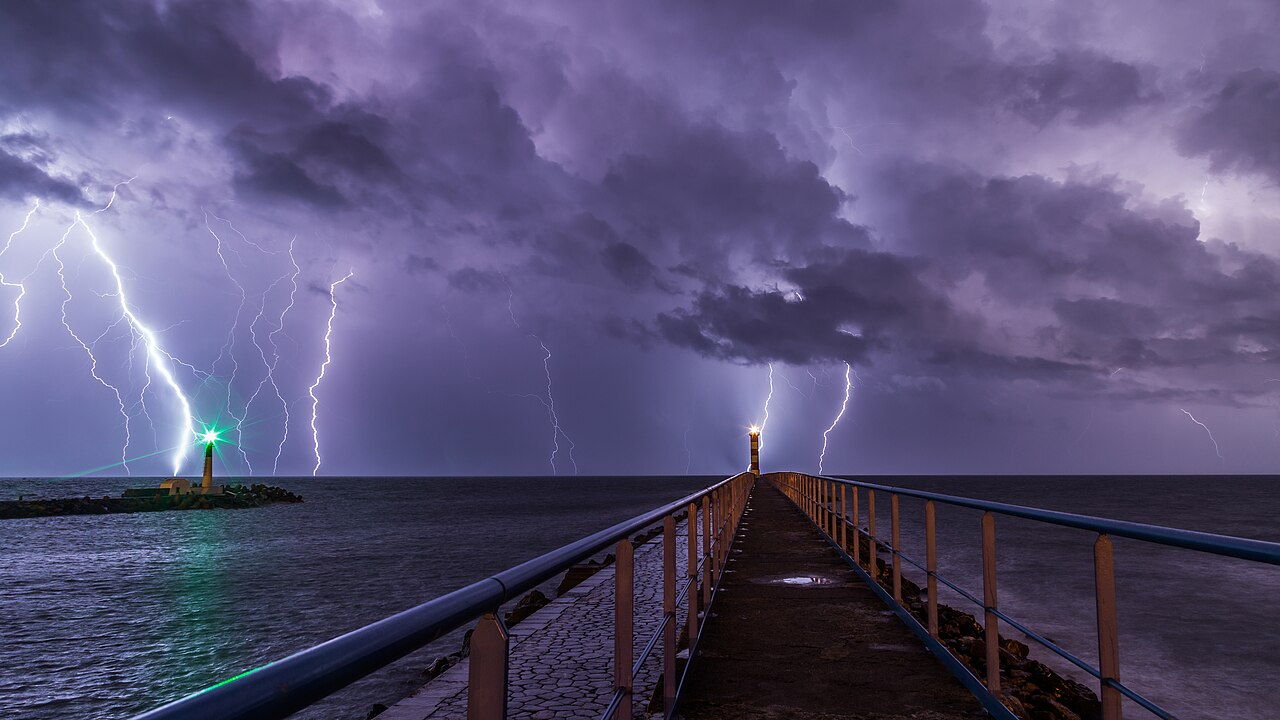
Atmospheric electricity refers to the naturally occurring electrical phenomena within Earth's atmosphere. Think of it as the planet's own built-in electrical system, a constant hum of charge that influences everything from weather patterns to radio wave propagation. It's not just about dramatic lightning strikes; it encompasses subtle electric fields, ion concentrations, and charge transfer processes occurring daily. Understanding this field requires grasping concepts from electrostatics and atmospheric physics, making it a fascinating nexus of disciplines.
🌍 The Global Atmospheric Electrical Circuit
The heart of atmospheric electricity is the global atmospheric electrical circuit. This circuit describes the continuous flow of electrical charge between the Earth's surface, the atmosphere, and the ionosphere, driven primarily by thunderstorms acting as giant atmospheric generators. This global current, estimated to be around 1-3 kiloamperes (kA) on average, maintains a potential difference of about 250,000 volts between the Earth and the ionosphere. It's a fundamental aspect of our planet's electrodynamics, linking disparate regions through invisible electrical pathways.
⚡ Historical Roots & Key Discoveries
The study of atmospheric electricity boasts a rich history, stretching back to Benjamin Franklin's famous kite experiment in 1752, which demonstrated the electrical nature of lightning. Later, scientists like Charles Thomson Rees Wilson (Nobel Prize winner for cloud chamber invention) and Elmer Harrison Williams made significant contributions to understanding atmospheric conductivity and charge distribution. The early 20th century saw the formalization of the global circuit concept, building upon decades of observation and theoretical work in electromagnetism.
⚡ Measuring the Unseen: Instrumentation
Measuring atmospheric electricity involves specialized instrumentation designed to detect faint electric fields and ion concentrations. Devices like field mills measure electric field strength, while ion counters quantify the density of positive and negative ions. Balloon-borne instruments and ground-based observatories are crucial for continuous monitoring of parameters like air conductivity and potential gradient. These tools allow us to quantify phenomena that are otherwise imperceptible to human senses.
⚡ Applications & Implications
The implications of atmospheric electricity are far-reaching, extending beyond pure scientific curiosity. Understanding it is vital for aviation safety, particularly concerning lightning strikes and electromagnetic interference with aircraft systems. It also plays a role in atmospheric chemistry, influencing the formation and behavior of aerosols and pollutants. Furthermore, research into atmospheric electricity could eventually inform novel energy harvesting technologies, though this remains largely speculative.
⚡ Controversies & Unanswered Questions
Despite significant progress, atmospheric electricity is not without its controversies and unanswered questions. The precise mechanisms driving the global circuit's variability, especially during periods of low thunderstorm activity, are still debated. The exact influence of cosmic rays on atmospheric ionization and their role in cloud formation remains a subject of ongoing research and contention. Some theories even propose connections to geomagnetic storms and their impact on terrestrial weather, though these are often on the fringes of mainstream atmospheric science.
⚡ Vibepedia Vibe Score & Outlook
Vibepedia's Vibe Score for Atmospheric Electricity currently sits at a solid 78/100. This reflects its foundational importance in Earth science, its historical resonance, and its ongoing relevance to critical technological and environmental concerns. The field is characterized by a strong consensus on fundamental principles but retains a vibrant undercurrent of debate regarding finer details and potential applications. The future outlook is optimistic, with advancements in sensing technology and computational modeling promising to unlock deeper insights into this essential planetary system. The potential for geoengineering discussions to intersect with atmospheric electricity also adds a layer of future intrigue.
Key Facts
- Year
- 1752
- Origin
- Benjamin Franklin's kite experiment
- Category
- Physics & Earth Science
- Type
- Scientific Field
Frequently Asked Questions
Is atmospheric electricity dangerous?
Direct exposure to the electrical phenomena of the atmosphere, particularly lightning, is extremely dangerous and can be fatal. However, the general electrical fields and ion concentrations that constitute atmospheric electricity are not typically harmful to humans at ground level. The primary concern is for direct strikes or proximity to electrical discharges.
How is atmospheric electricity measured?
Atmospheric electricity is measured using specialized instruments like field mills to detect electric fields, ion counters for ion density, and conductivity probes. These are often deployed at ground-based observatories, on balloons, or aircraft to capture data across different atmospheric altitudes and conditions. Continuous monitoring is key to understanding the global atmospheric electrical circuit.
What is the difference between atmospheric electricity and weather electricity?
Atmospheric electricity is the broader term encompassing all electrical phenomena in the atmosphere, including fair-weather electric fields and ion currents. Weather electricity is a subset, specifically referring to the electrical activity associated with weather systems, most notably thunderstorms and lightning. So, while all weather electricity is atmospheric electricity, not all atmospheric electricity is directly tied to active weather events.
Can we harness atmospheric electricity for power?
The concept of harnessing atmospheric electricity for power generation has been explored, notably by Nikola Tesla. While thunderstorms generate immense energy, capturing and controlling it efficiently and safely on a large scale remains a significant engineering challenge. Current practical applications are limited, though research continues into potential low-level energy harvesting methods.
What role does the ionosphere play in atmospheric electricity?
The ionosphere acts as the upper conductor in the global atmospheric electrical circuit. Its conductive nature, due to ionization by solar and cosmic radiation, allows it to maintain a high electrical potential relative to the Earth's surface. This potential difference, along with the ionosphere's role in reflecting radio waves, is fundamental to the functioning of the atmospheric electrical circuit.