
Contents
Overview
The foundational work on memory and forgetting, which underpins active recall, dates back to the late 19th century with Hermann Ebbinghaus's pioneering studies on the forgetting curve. While Ebbinghaus focused on how quickly we forget, his experiments laid the groundwork for understanding memory's mechanics. The concept of 'retrieval practice' as a distinct learning benefit, however, gained significant traction in the late 20th and early 21st centuries. Researchers like Robert A. Bjork introduced the idea of 'desirable difficulties'—learning challenges that feel harder in the moment but lead to more robust, long-lasting learning. This contrasted sharply with the prevailing emphasis on fluency and ease in study methods. The term 'active recall' itself became widely popularized through educational psychology and self-help literature, distinguishing it from mere rereading or passive recognition.
⚙️ How It Works
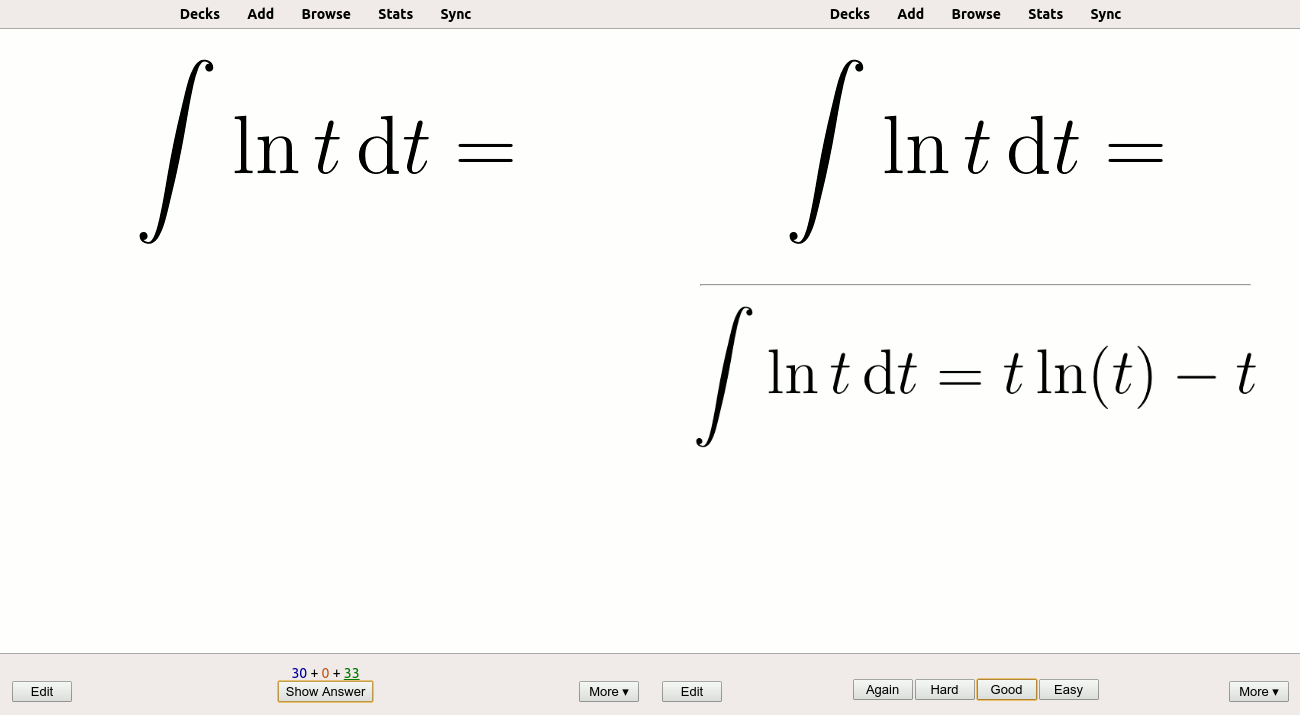
Active recall operates on a simple yet powerful cognitive mechanism: the act of retrieval itself strengthens memory traces. When you attempt to recall information, your brain actively searches for and reconstructs the relevant neural pathways. This effortful process makes the information more accessible for future recall. Unlike passive methods such as rereading notes, which can create a false sense of mastery, active recall forces you to confront what you don't know. Each successful retrieval acts as a 'memory consolidation' event, making the information more resistant to forgetting. This is often contrasted with 'desirable difficulties,' a broader concept that includes techniques like spaced repetition, which complements active recall by ensuring that retrieval attempts occur at optimal intervals.
📊 Key Facts & Numbers
Studies consistently demonstrate the efficacy of active recall. A single 20-minute quizzing session can be more beneficial than an hour of rereading the same material. The effect is particularly pronounced for complex concepts, where simply recognizing information is insufficient for true understanding.
👥 Key People & Organizations
Several key figures and institutions have been instrumental in popularizing and researching active recall. Henry L. Roediger III, a cognitive psychologist at Washington University in St. Louis, has extensively researched the testing effect and retrieval practice. Robert A. Bjork, a professor emeritus at UCLA, coined the term 'desirable difficulties' and highlighted the importance of effortful learning. Organizations like the Association for Psychological Science frequently publish research on these cognitive strategies. Educational technology platforms such as Quizlet and Anki have also played a significant role in bringing active recall tools to millions of students worldwide, making these techniques accessible and widely adopted.
🌍 Cultural Impact & Influence
Active recall has permeated educational philosophy and practice, shifting the focus from passive information absorption to active knowledge construction. It has influenced curriculum design, teaching methodologies, and the development of learning tools. The widespread adoption of flashcards, practice tests, and spaced repetition software like Anki are direct cultural outputs of this cognitive principle. Beyond academia, the concept resonates in professional development, where continuous learning is crucial, and even in everyday life for skill acquisition. The emphasis on 'learning how to learn' has become a meta-skill, with active recall as its central tenet, influencing how individuals approach acquiring any new knowledge or skill.
⚡ Current State & Latest Developments
The current landscape sees active recall integrated into mainstream educational strategies and learning technologies. Platforms like Quizlet and Anki continue to evolve, incorporating AI-driven features to optimize recall intervals and question generation. Educational institutions are increasingly training educators on how to implement retrieval practice effectively in classrooms, moving beyond traditional lecture-and-test models. There's also a growing interest in applying active recall principles to corporate training and lifelong learning initiatives, recognizing its power for durable skill development in rapidly changing professional environments. The ongoing research focuses on refining spaced repetition algorithms and understanding individual differences in response to retrieval practice.
🤔 Controversies & Debates
While widely accepted, active recall isn't without its nuances and debates. Some critics argue that the 'desirable difficulties' can be demotivating if not implemented carefully, leading to student frustration if the retrieval attempts are too challenging. There's also a discussion about the optimal balance between active recall and other study methods; some argue that passive review still has a role, particularly in initial exposure to material. Furthermore, the effectiveness can depend on the quality of the retrieval prompts and the learner's metacognitive awareness—understanding why active recall works is crucial for sustained motivation. The debate also touches on whether active recall is equally effective across all subjects and learning styles, with some research suggesting variations in impact.
🔮 Future Outlook & Predictions
The future of active recall likely involves deeper integration with artificial intelligence and personalized learning systems. AI could dynamically adjust the difficulty and timing of retrieval prompts based on individual performance, creating hyper-personalized learning paths. We might see more sophisticated applications in areas like medical education, legal training, and complex technical skill acquisition, where deep, durable knowledge is paramount. Research will likely continue to explore the neurological underpinnings of retrieval practice and its potential applications in cognitive rehabilitation and enhancing memory in aging populations. The goal is to make learning not just effective, but also more efficient and engaging.
💡 Practical Applications
Active recall is a versatile tool with numerous practical applications. In academic settings, students use it for exam preparation by creating flashcards, answering practice questions, and using spaced repetition software. Professionals use it for mastering new skills, remembering complex procedures, or retaining information from training sessions. Language learners employ it to memorize vocabulary and grammar rules, often using apps like Duolingo or Memrise. Even in everyday life, one can use active recall to remember names, facts, or instructions, simply by pausing and trying to recall the information without looking it up immediately. The core principle is to engage in self-testing rather than passive review.
Key Facts
- Category
- aesthetics
- Type
- concept