
Contents
Overview
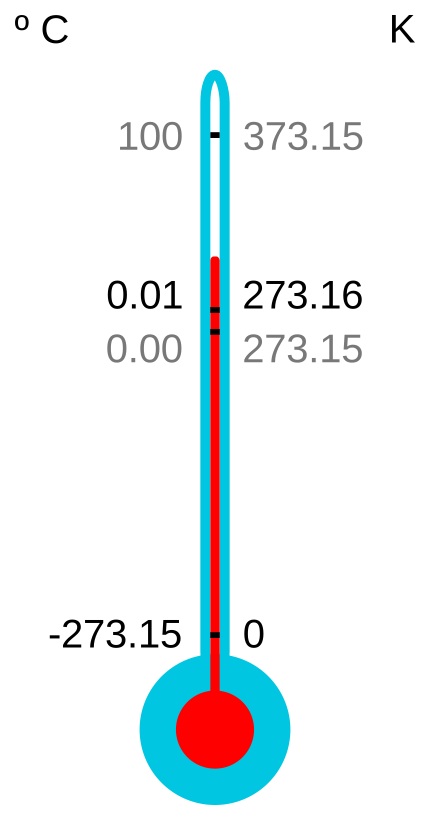
The concept of absolute zero emerged from centuries of scientific inquiry into heat and temperature. Early pioneers like Guillaume Amontons in the late 17th and early 18th centuries observed that the pressure of a gas decreased with temperature, suggesting a point where pressure might vanish. By 1800, John Dalton further speculated on a point of zero heat. The crucial breakthrough came in the mid-19th century when William Thomson, later Lord Kelvin, extrapolated the behavior of gases. The theoretical limit was later solidified by the Third Law of Thermodynamics, articulated by Walther Nernst in the early 20th century, which states that it is impossible to reach absolute zero through any finite number of processes.
⚙️ How It Works
Temperature, fundamentally, is a measure of the average kinetic energy of particles. Achieving temperatures close to absolute zero requires sophisticated cooling techniques, often involving cryogenic processes and laser cooling of atoms.
📊 Key Facts & Numbers
The cosmic microwave background radiation, a remnant of the Big Bang, represents the coldest natural temperature in the universe, averaging about 2.725 K.
👥 Key People & Organizations
The pursuit of understanding and approaching absolute zero has been driven by numerous scientists and institutions. Lord Kelvin (William Thomson) is credited with defining the absolute temperature scale. James Clerk Maxwell and Ludwig Boltzmann developed the kinetic theory of gases, providing a theoretical framework for temperature. Modern research is heavily supported by institutions like the National Institute of Standards and Technology (NIST) in the United States and the CERN in Europe, which house advanced cryogenic facilities and conduct cutting-edge experiments in superconductivity and quantum computing.
🌍 Cultural Impact & Influence
Absolute zero is more than just a scientific curiosity; it's a cultural touchstone for ultimate cold and theoretical limits. It features in science fiction as a plot device for freezing characters or creating exotic materials, such as in the film Frozen, where Elsa's powers are tied to ice and cold. The concept also appears in discussions about the universe's ultimate fate, with some cosmological models considering scenarios involving extreme cold. The term 'absolute zero' itself has entered common parlance to describe a state of complete lack of emotion or energy, highlighting its pervasive influence beyond the laboratory. The quest to reach it has inspired countless experiments and technological advancements, pushing the boundaries of human ingenuity.
⚡ Current State & Latest Developments
Current research continues to push the boundaries of achievable cold, with scientists constantly striving to get closer to absolute zero. Advances in magnetic refrigeration and dilution refrigerators are enabling temperatures in the nanoKelvin range. The focus is increasingly on understanding the quantum phenomena that emerge at these extreme temperatures, such as Bose-Einstein condensates and superfluidity, which have potential applications in fields like quantum computing and precision measurement. The ongoing exploration of dark matter detection also relies on ultra-low temperature environments to minimize thermal noise.
🤔 Controversies & Debates
The primary debate surrounding absolute zero is its attainability. While the Third Law of Thermodynamics strongly suggests it's impossible to reach absolute zero in a finite number of steps, some theoretical physicists explore hypothetical scenarios or exotic states of matter that might approach or even, under highly specific and theoretical conditions, 'touch' zero. Another point of discussion is the precise nature of zero-point energy and its implications for the vacuum state of the universe. Critics sometimes question the practical utility of achieving ever-lower temperatures, arguing that the immense energy expenditure might outweigh the scientific gains, though proponents highlight the fundamental knowledge and technological spin-offs.
🔮 Future Outlook & Predictions
The future outlook for research into absolute zero is one of continued exploration and discovery. Scientists anticipate developing even more efficient and precise cooling technologies. This will unlock new avenues for studying exotic quantum states of matter, such as fermionic condensates and novel forms of superconductivity. Furthermore, understanding the behavior of matter at these extreme temperatures is crucial for developing next-generation quantum computers and highly sensitive sensors. The quest to understand the universe's fundamental properties, from the nature of dark energy to the behavior of black holes, may also benefit from insights gained at near-absolute zero conditions.
💡 Practical Applications
The practical applications of achieving temperatures near absolute zero are vast and transformative. Superconductors, materials that conduct electricity with zero resistance, only function at extremely low temperatures, enabling technologies like powerful MRI scanners, particle accelerators such as those at CERN, and high-speed magnetic levitation trains. Cryogenic cooling is essential for sensitive scientific instruments, including those used in astronomy and particle physics, and for the storage of biological samples like stem cells and gametes. The development of quantum computers relies heavily on maintaining qubits at extremely low temperatures to preserve their delicate quantum states, a process that requires sophisticated cryogenic systems. Even everyday technologies like LCD screens utilize principles derived from low-temperature physics.
Key Facts
- Category
- science
- Type
- topic