
Contents
Overview
The Roland TR-808 Rhythm Composer was conceived in the late 1970s by Roland founder Ikutaro Kakehashi and engineer Don Lewis, who wanted to create an affordable drum machine for musicians recording demos. Unlike its competitor, the Linn LM-1, which used expensive memory chips to play sampled drum sounds, the 808 team led by Tadao Kikumoto chose to use analog synthesis—manipulating electrical currents to generate sounds electronically. Kakehashi deliberately purchased faulty transistors to create the machine's distinctive sizzling character, a decision that would become central to its legendary sound. The 808 was officially launched in 1980 and manufactured until 1982, with approximately 12,000 units produced during its initial run. Early adopters like Japan's Yellow Magic Orchestra used the 808 in live performances, but the machine was initially dismissed by mainstream producers who found its synthetic sounds too simplistic and unrealistic compared to sampled alternatives.
⚙️ How It Works
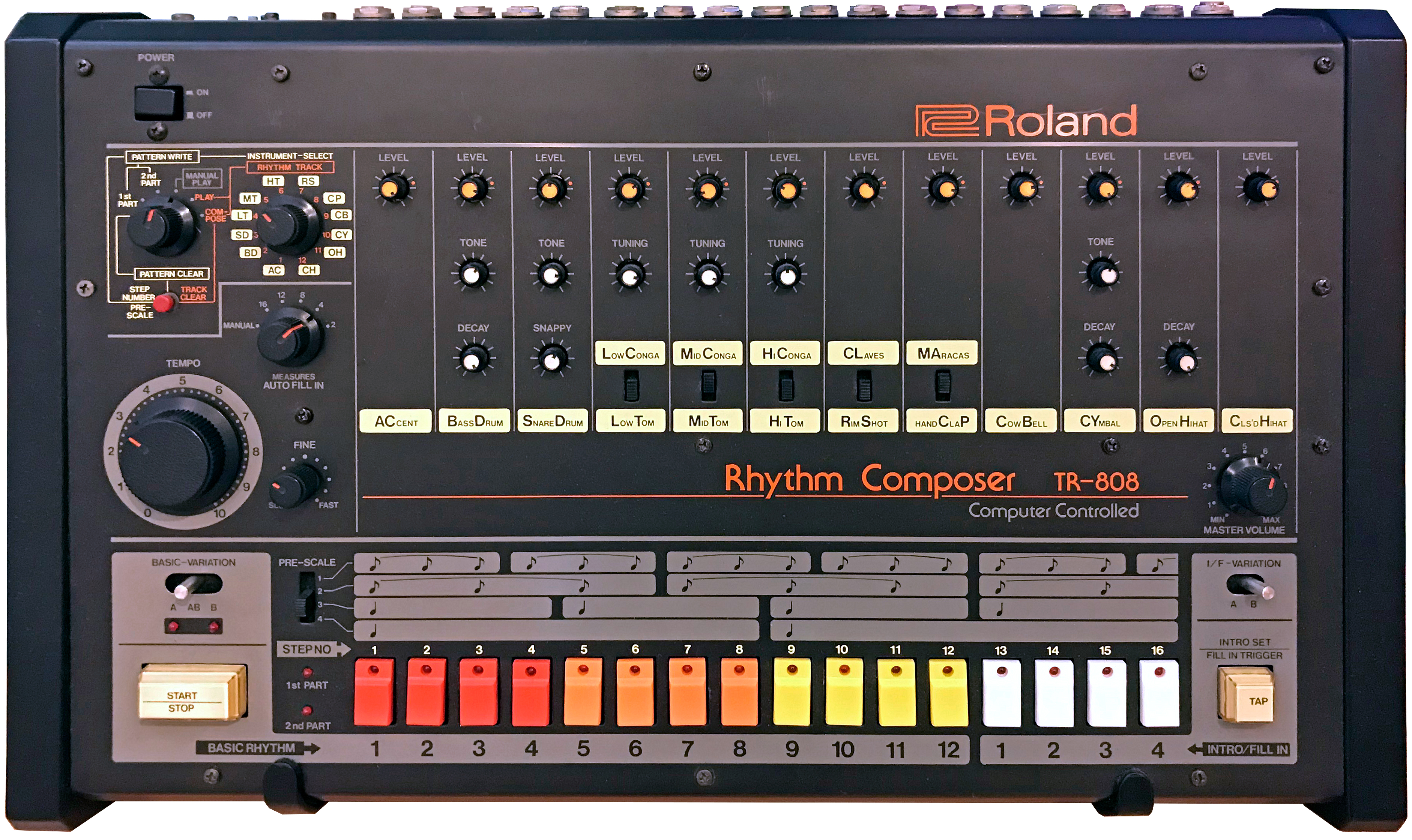
The 808 generates 16 distinct percussive sounds using analog synthesis: bass drum, snare, toms, conga, rimshot, claves, handclap, maraca, cowbell, cymbal, and hi-hat (open and closed). The machine's most iconic feature is its powerful bass drum, built from a sine oscillator, low-pass filter, and voltage-controlled amplifier—the decay control allows users to extend the sound and create uniquely low frequencies that flatten over time, giving it that warm, punchy character that became legendary in music production. Unlike preset-based machines like Roland's earlier CR-78, the 808 features a 16-step sequencer that allows users to program their own patterns from scratch, edit individual beats, place accents, and chain up to 768 measures together. Users can adjust parameters like tuning, decay, and level for each sound, and set custom tempos and time signatures including unusual signatures like 5/4. The TR-REC method of beat creation pioneered by the 808 remains in use in music production today, demonstrating the machine's fundamental influence on how musicians interact with drum machines.
🌍 Cultural Impact & Legacy
The 808's impact on music culture cannot be overstated. In the early 1980s, producer Arthur Baker experimented with the 808 in New York studios and created 'Planet Rock,' a collaboration between Afrika Bambaataa and the Soul Sonic Force that reached No. 48 on the Billboard charts in 1982 and became one of the most influential records of the decade, helping spark the first golden era of hip-hop. After its initial commercial failure, the 808 attracted a cult following among musicians who discovered its secondhand availability and began exploring its unique sonic possibilities, particularly its deep, booming bass drum that could literally blow out speaker cones when cranked up. The machine became essential to emerging genres like house, techno, electro, and hip-hop throughout the 1980s and beyond. Artists and producers realized that the 808's synthetic, unrealistic sounds were actually its greatest strength—they could create something that had never been heard before, making the machine a living and breathing studio unto itself. The influence of the 808 has been such that even today it remains ubiquitous in trap, pop, EDM, and virtually every electronic music genre, with producers from Aphex Twin to contemporary artists continuing to sample and recreate 808 sounds.
🔮 The 808 Today
Despite being discontinued in 1983 due to improvements in transistor production that made the faulty transistors unavailable, the 808 has experienced a remarkable renaissance over four decades. The machine's analog character and programmable nature made it timeless—it wasn't bound to a specific era or trend but rather became a foundational tool that transcends genres. Modern producers continue to use original 808 units, digital emulations, and software recreations of the machine, proving that its core design principles remain relevant. The 808's legacy extends beyond music into broader culture, influencing how we think about accessibility in music production, the value of 'imperfect' or unconventional sounds, and the importance of giving artists creative control over their tools. The machine demonstrated that a commercial failure could become a cultural phenomenon through the creativity of dedicated users who saw potential where manufacturers saw limitations. Today, the 808 stands as a testament to the power of analog synthesis, the importance of user programmability, and how a single instrument can fundamentally reshape the landscape of popular music and inspire generations of musicians and producers.
Key Facts
- Year
- 1980-1983 (production); 1980-present (cultural impact)
- Origin
- Roland Corporation, Japan
- Category
- technology
- Type
- product
Frequently Asked Questions
Why was the 808 initially considered a commercial failure?
The 808 was dismissed by mainstream producers in 1980 because its synthetic, analog sounds were considered too simplistic and unrealistic compared to sample-based competitors like the Linn LM-1. The machine was designed to be affordable, but the market at the time valued realistic drum samples over creative synthesis. Only about 12,000 units were sold during its two-year production run, making it commercially unsuccessful at launch. However, musicians who bought used 808s in the secondhand market discovered its unique creative potential, transforming it into a cult classic.
What makes the 808's bass drum sound so distinctive?
The 808's bass drum is built from a sine oscillator, low-pass filter, and voltage-controlled amplifier, with a decay control that allows users to extend the sound and create uniquely low frequencies that flatten slightly over time. This warm, punchy character comes from the machine's analog synthesis approach rather than sampled sounds. Additionally, Ikutaro Kakehashi deliberately purchased faulty transistors to create the machine's characteristic sizzling sound, which became central to its sonic identity. The combination of these design choices created a bass drum so powerful it could literally blow out speaker cones when cranked up.
How did the 808 influence hip-hop and electronic music?
The 808 became foundational to hip-hop through producer Arthur Baker's work on 'Planet Rock' (1982), a collaboration with Afrika Bambaataa that reached No. 48 on the Billboard charts and sparked the first golden era of hip-hop. The machine's deep, booming bass drum became the heartbeat of hip-hop production. Beyond hip-hop, the 808 was essential to emerging genres like house, techno, and electro throughout the 1980s. Its influence has persisted for over four decades, remaining ubiquitous in trap, pop, EDM, and virtually every electronic music genre today. The 808 essentially gave musicians the tools to create entirely new sounds that had never been heard before.
What was revolutionary about the 808's step sequencer?
The 808's 16-step sequencer was revolutionary because it allowed users to easily program their own drum patterns directly on the machine, unlike its predecessor the CR-78, which required external footswitches or special write switches to program. Users could quickly punch in and edit patterns, place accents on individual beats, and chain up to 768 measures together. The machine provided instant visual feedback through its distinctively colored buttons. This accessibility and creative control made the 808 a 'living and breathing studio unto itself,' giving musicians remarkable freedom to fashion sounds and stack them in ways that had never been possible before.
Why was the 808 discontinued if it became so influential?
The 808 was discontinued in 1983 because improvements in transistor production made the faulty transistors that created the machine's distinctive sound no longer available. Ironically, the very manufacturing 'flaw' that gave the 808 its iconic character became impossible to replicate as transistor technology improved. By the time the machine was discontinued, it had already begun attracting a cult following among musicians who discovered its unique sonic possibilities on the secondhand market. The 808's discontinuation actually contributed to its mystique and desirability, as original units became increasingly rare and sought-after by producers.
References
- en.wikipedia.org — /wiki/Roland_TR-808
- redbull.com — /za-en/History%20of%20The%20Roland%20TR-808%20Rhythm%20Composer
- roland.com — /global/promos/roland_tr-808/
- beatsbeyondborders.com — /editorials/four-decades-one-sound-history-of-the-808-drum-machine/
- youtube.com — /watch
- smithsonianmag.com — /arts-culture/history-tr-808-drum-machine-180975205/
- the-drop.serato.com — /culture/the-history-of-the-808/
- sweetwater.com — /insync/history-roland-808/